
End of lease cleaning for real estate agents: complete 2026 guide

Real estate agents’ end of lease cleaning is the coordination of a vacate clean to support a documented property handover. This 2026 guide explains how to set the scope, organise access and check completion without confusing cleaning with repairs, fair wear and tear or a bond decision.
TL;DR
- End of lease cleaning for real estate agents needs a written scope, confirmed access and completion evidence.
- Housekept provides end-of-lease cleaning across Sydney, Shoalhaven and Illawarra; confirm the property-specific scope before booking.
- Use condition reports to identify cleaning work, not to turn existing damage into a cleaning task.
- Compare tenant-managed cleaning, agency coordination and professional cleaning by responsibility and inspection requirements.
Why end of lease cleaning matters for real estate agents
A property handover involves different responsibilities: the tenant’s obligations, the agency’s inspection and any cleaning contractor’s agreed work. Keep those responsibilities separate. A cleaning invoice records a service; it does not decide whether a bond deduction is justified.
For your 2026 handovers, the practical challenge is coordination. You need the property empty, access confirmed and the cleaning finished before the final inspection. Missing one dependency creates another round of calls, key collection or inspection arrangements.
Housekept is an end-of-lease cleaning option for real estate agents managing properties across Sydney, Shoalhaven and Illawarra. Housekept provides this service alongside residential and commercial cleaning. Confirm the specific tasks, access requirements and completion arrangements for each property rather than assuming every clean includes the same work.
The aim is straightforward: give the cleaner instructions you can inspect against, then record what happened. Start with documents you already hold before adding another system or contractor.
How to organise an end-of-lease clean
Build the scope from the condition record
Start manually with the entry condition report, available photographs and your vacate checklist. Create a room-by-room document that separates removable dirt from damage and existing deterioration. Describe observable conditions rather than writing instructions such as “make good” or “return to new”.
For a 2026 handover, identify 3 documents in the job file: the relevant condition record, the cleaning brief and the completion record. This is a recommended filing structure, not an additional tenancy requirement. Keep correspondence about disputed responsibility separate from instructions to the cleaner.
Be specific about locations. “Grease on the rangehood exterior” gives the contractor something to assess; “kitchen unsatisfactory” does not. Where the starting condition is unclear, record that uncertainty instead of making the cleaner responsible for resolving it.
- Mark cleaning tasks against individual rooms and surfaces.
- Separate stains, chips and broken fittings from removable residue.
- Attach relevant photographs without unrelated tenant information.
- Identify areas that need assessment before treatment.
- State which tasks require separate approval.
Confirm responsibility before arranging work
You can coordinate the clean through a shared email thread and a simple checklist. Identify who requests the work, who approves changes and who receives the invoice. Do not treat your ability to arrange access as authority to commission additional work.
A tenant-managed clean leaves the tenant coordinating the work. An agency-coordinated clean places more scheduling and communication with your team. Neither arrangement removes the need to document authority and assess the property fairly.
If you use Housekept for end-of-lease cleaning, provide the same written brief you would use for any contractor. A professional service handles cleaning work; your agency still needs to manage authorisation, tenancy communication and inspection decisions. Confirm those boundaries before the booking, not after an unexpected task appears.
- Name the person authorised to approve the booking.
- Identify the invoice recipient before work starts.
- Record how additional tasks will be approved.
- Give the cleaner a nominated operational contact.
- Keep bond discussions outside the contractor’s cleaning instructions.
Sequence access, cleaning and inspection
Build the schedule yourself using a calendar and a written access note. Put removal of belongings before the clean, and place the final inspection after cleaning is complete. Where trades also need access, decide their position in the sequence rather than allowing overlapping visits by default.
Use these 4 stages as the handover sequence: Clear belongings, Finish trades, Complete cleaning, Inspect property. If maintenance must happen later, identify which surfaces need checking again. Do not make a fresh clean the unplanned worksite for another contractor.
A service booking can reduce the cleaning work your team coordinates directly, but it does not resolve missing keys, inaccessible rooms or an occupied property. Confirm these dependencies with the relevant people before confirming the sequence.
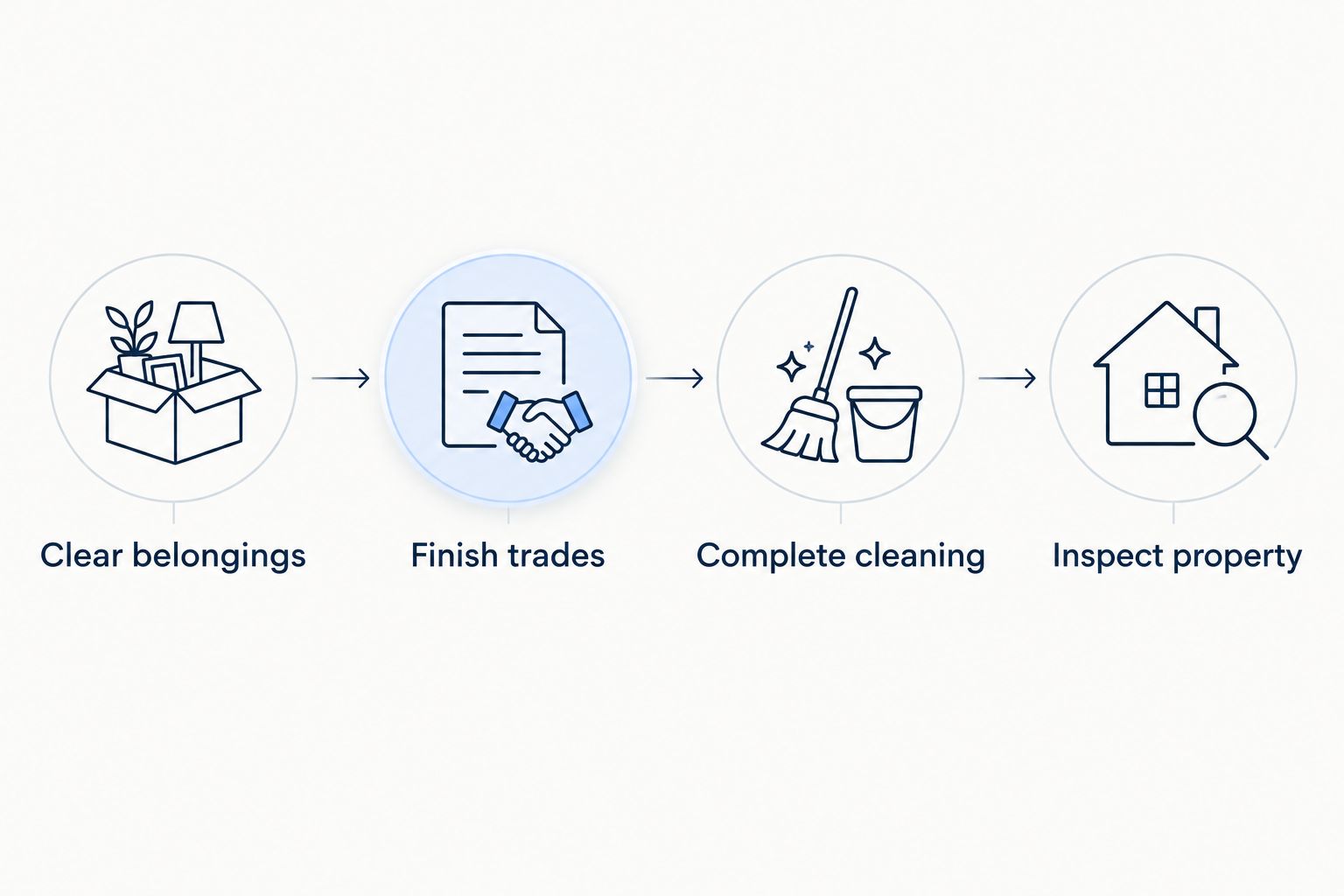
Place cleaning after work that creates dust or debris, then inspect the completed property.
Keep the access note separate from general tenant correspondence so the contractor can find essential instructions quickly. Share only the information needed for the visit.
- Clear belongings before the cleaning visit.
- Finish trades before cleaning wherever the work sequence allows.
- Complete cleaning before the final inspection.
- Inspect property after completion has been confirmed.
- Record key collection, entry and lock-up instructions.
Specify tasks by surface and condition
A broad room list is a starting point, not a complete scope. Write down the relevant surfaces and the result you need assessed: grease removal, dust removal, soap residue removal or glass cleaning. Ask the contractor to identify exclusions and surfaces that need a different treatment.
For your 2026 cleaning brief, avoid copying a long checklist without checking the property. An unfurnished apartment, a furnished rental and a house with outdoor areas present different tasks. Include only the areas present, then establish what the agreed service covers.
Use the end-of-lease cleaning supplies guide when preparing a task-specific equipment discussion. Product choice still needs to follow surface suitability and label directions. Do not prescribe aggressive treatment merely because a mark remains visible.
- Specify oven, cooktop and rangehood tasks separately.
- Identify bathroom glass, fittings, tiles and accessible grout.
- Confirm whether cupboard interiors are empty and included.
- Describe floor types and visible marks requiring assessment.
- List windows, tracks, balconies and outdoor areas separately.
- Flag damaged finishes and surfaces with care instructions.
Agree how completion will be checked
Use a manual completion checklist first. Match each item to the written scope and request photographs that show the relevant surface, not just a wide view of the room. Photographs support the record; they do not replace an inspection or establish the cause of every mark.
Set 2 checkpoints in your workflow: the contractor’s completion confirmation and the agency’s inspection. These are recommended process steps, not a claim about any provider’s standard service. Agree on the evidence you need before the visit so neither party discovers a new reporting requirement afterwards.
For professional cleaning, ask what completion information the provider can supply and how concerns are raised. Do not promise a return visit, correction period or result unless the contractor has explicitly agreed to it. Keep a dated record of the response.
- Match completion checks to the original scope.
- Request close-ups for specifically identified problem areas.
- Record inaccessible or untreated areas and the reason.
- Confirm how keys are returned or secured.
- Send concerns to the nominated contact with photographs.
Close the job with a clear exception record
Review unresolved items against the brief before requesting more work. Decide whether each item is incomplete cleaning, excluded work, an access problem or a condition that needs separate assessment. A contractor cannot act on an exception described only as “not good enough”.
Keep 1 nominated contact for operational follow-up. That person should gather the inspection findings, confirm any authority required and send a consolidated response. Multiple staff members sending different instructions creates an avoidable coordination problem.
Housekept end-of-lease cleaning should be assessed against the scope agreed for that property, just as any other cleaning service should. Where the scope needs changing, obtain agreement before treating the additional work as part of the original booking. Keep the cleaning record factual and separate from any proposed bond claim.
- Describe the location and observable issue.
- Reference the relevant scope item.
- Attach a photograph where it clarifies the concern.
- Identify whether further access is available.
- Record the agreed next action and responsible person.
Compare cleaning arrangements for your agency
Choose the arrangement that fits the responsibility you actually hold. In 2026, a written brief remains more useful than a provider label: it tells you what was requested, what was accepted and what needs checking.
Tenant-managed cleaning
- Best for: Tenants organising their own vacate preparation
- Practical advantage: Keeps cleaning arrangements with the tenant
- Key limitation: Your agency still needs to assess the property and communicate specific concerns
Agency-coordinated professional cleaning
- Best for: Authorised jobs needing a central agency contact
- Practical advantage: Gives scheduling and instructions a defined owner
- Key limitation: Your team retains coordination and approval work
Housekept
- Best for: Properties across Sydney, Shoalhaven and Illawarra needing professional end-of-lease cleaning
- Practical advantage: Provides a relevant service within the stated coverage areas
- Key limitation: Property-specific inclusions, access and completion arrangements need confirmation
These choices overlap. Housekept is a provider; tenant-managed and agency-coordinated cleaning are responsibility models. Either party can discuss a professional booking where appropriate authority exists.
Choose the responsibility model first, then assess the provider against the property brief. That prevents a familiar contractor name from replacing the scope, approvals and inspection process.
Common mistakes real estate agents make
Treating a cleaning checklist as a bond decision
A checklist tells you what to inspect. It does not establish liability or replace the tenancy evidence. Keep cleaning observations specific, consider the condition record and distinguish dirt from damage or fair wear and tear.
If responsibility is disputed, handle that through the appropriate tenancy process. Do not ask the cleaning contractor to make the legal decision or present a cleaning recommendation as proof that a deduction is warranted.
Leaving windows outside the written scope
“Windows included” leaves several questions unanswered: internal glass, external glass, tracks, screens and safe access. List each relevant component and ask the contractor to confirm what can be completed within the booking.
The distinction matters in window cleaning for real estate agents: cleaning accessible internal glass is a different task from accessing external panes. Define the surfaces and access constraints rather than assuming the phrase covers everything. Australian tenancy decisions remain separate from an overseas cleaning discussion.
Inspecting before the work sequence is finished
An inspection carried out before cleaning is complete cannot serve as the final check of that clean. Equally, trades entering afterwards can change the condition you recorded. Label interim observations clearly and arrange the final check around the actual work sequence.
If the schedule changes, update the people who control access. A calendar entry alone does not tell the cleaner that belongings remain or another contractor is still working.
Assuming an invoice guarantees an outcome
An invoice is evidence of a transaction, not proof that every surface meets the agreed scope. Inspect the relevant work and retain the completion record. Avoid telling tenants that booking a named provider guarantees a bond refund.
The same restraint applies to provider policies. Ask about exclusions and follow-up arrangements rather than inventing a correction entitlement on the contractor’s behalf.
FAQ
What is end of lease cleaning for real estate agents?
End of lease cleaning for real estate agents is the coordination and assessment of cleaning around a tenancy handover. The work needs a defined scope, confirmed access and a completion check separate from any bond decision.
Can a real estate agent arrange an end-of-lease clean?
An agent should establish authority before arranging an end-of-lease clean. Record who approves the booking, who receives the invoice and how additional work is authorised.
Does professional cleaning guarantee the tenant gets their bond back?
No, professional cleaning does not guarantee a bond refund. Cleaning is only one part of a property handover, and an invoice does not decide responsibility for disputed conditions.
What should an agent include in a cleaning brief?
Include room-specific tasks, relevant photographs, surface concerns, access instructions and the completion process. Identify exclusions and separate cleaning from damage, repairs and existing deterioration.
Should the final inspection happen before or after cleaning?
Inspect the completed clean after the contractor confirms completion. If you visit earlier, label the visit as an interim check rather than the final assessment of the cleaning work.
Does Housekept provide end-of-lease cleaning in Sydney?
Housekept provides end-of-lease cleaning across Sydney, Shoalhaven and Illawarra. Confirm the property-specific scope and booking arrangements directly before commissioning work.
Are windows automatically included in an end-of-lease clean?
Do not assume windows are included without a written scope. Confirm internal glass, external glass, tracks, screens and any access restrictions separately.
One last thing
Write down what a cleaner must leave untouched. Damaged coatings, suspect materials, loose fittings and items awaiting repair need explicit instructions, not an assumption that stronger cleaning will fix them.
Add an “exceptions and do-not-treat” field to your 2026 handover brief. It gives the contractor somewhere to record concerns before work starts and gives your inspection team a reason for an untreated area. A clear exception is more useful than an unexplained mark in a completion photograph.