
How often should you book a deep clean versus a regular clean?

Book regular cleaning often enough to keep everyday dirt under control; book a deep clean when built-up grime or neglected areas need attention beyond that routine. Use weekly or fortnightly visits as scheduling options, not a universal rule, and arrange deeper work around the condition of your home. A deep-clean booking does not automatically include every appliance, window or hard-to-reach surface: agree on the tasks before booking.
TL;DR
- How often deep clean vs regular clean? Schedule maintenance around daily use and deeper work around accumulated grime.
- Housekept provides home cleaning across Sydney, Shoalhaven and Illawarra; confirm the task list before booking.
- Regular cleaning suits ongoing upkeep; deep cleaning suits areas that routine maintenance has not addressed.
- Choose frequency and scope separately: more visits do not automatically mean more detailed cleaning.
How often should you book a deep clean versus a regular clean?
Use regular cleaning to maintain your home and deep cleaning to address a defined backlog. The right interval depends on what happens between visits, not simply how long it has been since the last booking.
For your 2026 cleaning plan, start by separating maintenance tasks from detailed work. Housekept provides professional home cleaning across Sydney, Shoalhaven and Illawarra; discuss the condition of your home and the work you need rather than relying on a booking label alone.
Regular cleaning
- Best for: Keeping an already manageable home under control
- When to book: When routine dust, floor dirt and bathroom cleaning need attention
- Main benefit: Establishes a repeatable maintenance routine
- Main limitation: A maintenance task list can leave accumulated grime untouched
Deep cleaning
- Best for: Addressing neglected detail and stubborn build-up
- When to book: When specific areas need work beyond the agreed routine
- Main benefit: Directs attention to work that maintenance has missed
- Main limitation: Detailed work does not replace ongoing upkeep
Treat these as ways to describe the work, not standardised service inclusions. Ask what your cleaner means by each option.
Why this matters
A scheduling problem and a scope problem need different fixes. If your floors become dirty well before the next visit, review frequency. If the floors stay manageable but greasy cupboard fronts remain untouched, review the task list.
Booking more often without changing the scope can leave the same neglected areas behind. Booking a deep clean without arranging ongoing upkeep leaves you responsible for maintaining the result.
Decide what needs cleaning before deciding how often someone should come. That keeps the conversation focused on the work your home needs.
Regular cleaning: choose an interval you can maintain
Regular cleaning works best when you know which tasks belong in every visit. Discuss floors, accessible surfaces, kitchen cleaning and bathroom cleaning, then confirm which tasks the cleaner includes.
Do not assume tidying, laundry, dishes or changing beds forms part of the booking. Those jobs affect how the visit is organised and need their own agreement.
Weekly visits: best for frequent maintenance needs
Consider weekly visits when everyday dirt returns before you can comfortably deal with it yourself. This is a planning choice for a busy household, not a claim that every occupied home needs weekly professional cleaning.
The benefit is a shorter gap between maintenance visits. The limitation is that a weekly appointment still follows its agreed scope: detailed appliance cleaning or neglected edges do not become included simply because visits are frequent.
Fortnightly visits: best when you handle cleaning between visits
Consider fortnightly visits when you can manage spills, kitchen mess and other immediate jobs between professional cleans. Use the condition of your home before the next appointment to judge whether the interval works.
The benefit is room for a shared routine between you and your cleaner. The limitation is the work you retain: if you cannot manage the in-between tasks, the schedule needs changing rather than wishful thinking.
Less frequent visits: best when professional help supplements your routine
Less frequent appointments suit a plan where you already manage routine cleaning and want help with an agreed list. Be clear whether you want general maintenance or concentrated work in particular rooms.
The benefit is control over the purpose of each visit. The limitation is continuity: occasional professional help does not maintain the home between appointments. Keep your own routine realistic.
Deep cleaning: book against a task list, not a season
Book deeper work when you can name what ordinary upkeep is not resolving. A calendar reminder can prompt an inspection, but the inspection should determine the booking.
Look for greasy surfaces, dusty edges, residue around fittings and areas repeatedly skipped during normal cleaning. Describe the location and condition rather than asking for everything to be made spotless.
For a 2026 deep-clean checklist, split the work into clear groups:
- Kitchen detail: identify greasy cupboard fronts, splashbacks or appliance surfaces needing attention.
- Bathroom detail: identify soap residue, affected fittings and accessible areas needing more detailed cleaning.
- Dust and edges: identify skirting boards, ledges and accessible corners omitted from routine work.
- Access-dependent work: identify areas behind furniture or inside cupboards and agree on preparation.
These are discussion points, not promised inclusions. Internal ovens, windows, carpets and other specialist tasks need explicit confirmation.
A deep clean also has limits. Cleaning cannot repair damaged finishes, fix a leak or resolve the underlying cause of recurring dampness. Report maintenance problems separately rather than repeatedly adding them to a cleaning list.
Why cleaning frequency varies
Your cleaning schedule should reflect how your home is used and what you can manage between appointments. These factors help you make that decision without treating an arbitrary interval as a household standard.
- Occupancy and room use: judge the rooms people actually use, not bedroom count alone. An unused room and a shared bathroom have different maintenance needs.
- Pets and tracked-in dirt: note where hair, footprints or outdoor debris collect. Name those areas when setting priorities.
- Cooking habits: inspect the surfaces around food preparation. Frequent wiping and accumulated grease require different work.
- Between-visit cleaning: be honest about what you will do yourself. A plan that depends on tasks you cannot complete needs revision.
- Access and clutter: tell the cleaner which surfaces are accessible. Clearing a bench and cleaning it are separate jobs.
- The current backlog: distinguish dirt left since the last visit from areas that have not received attention for much longer.
For your 2026 review, compare the same areas before each appointment. That gives you a clearer basis for changing frequency than judging the whole home from a single untidy room.
How do you choose the next booking?
Use this sequence to turn a general request into a workable cleaning brief. You do not need to clean the home first; you need to describe it accurately.
- Inspect the home. Walk through the rooms you want included and note what needs attention. Separate loose belongings from dirty surfaces.
- Name the backlog. Write down grime or neglected detail that remains after ordinary cleaning. Mention relevant surface materials and access restrictions.
- Agree on scope. Confirm the rooms, tasks, exclusions and preparation. Ask how the cleaner will handle work outside the agreed brief.
- Set the interval. Choose a recurring schedule based on the maintenance work you need help with. Keep detailed catch-up work separate where necessary.
- Review the result. Check whether the agreed tasks were completed and whether the home remains manageable until the next appointment.
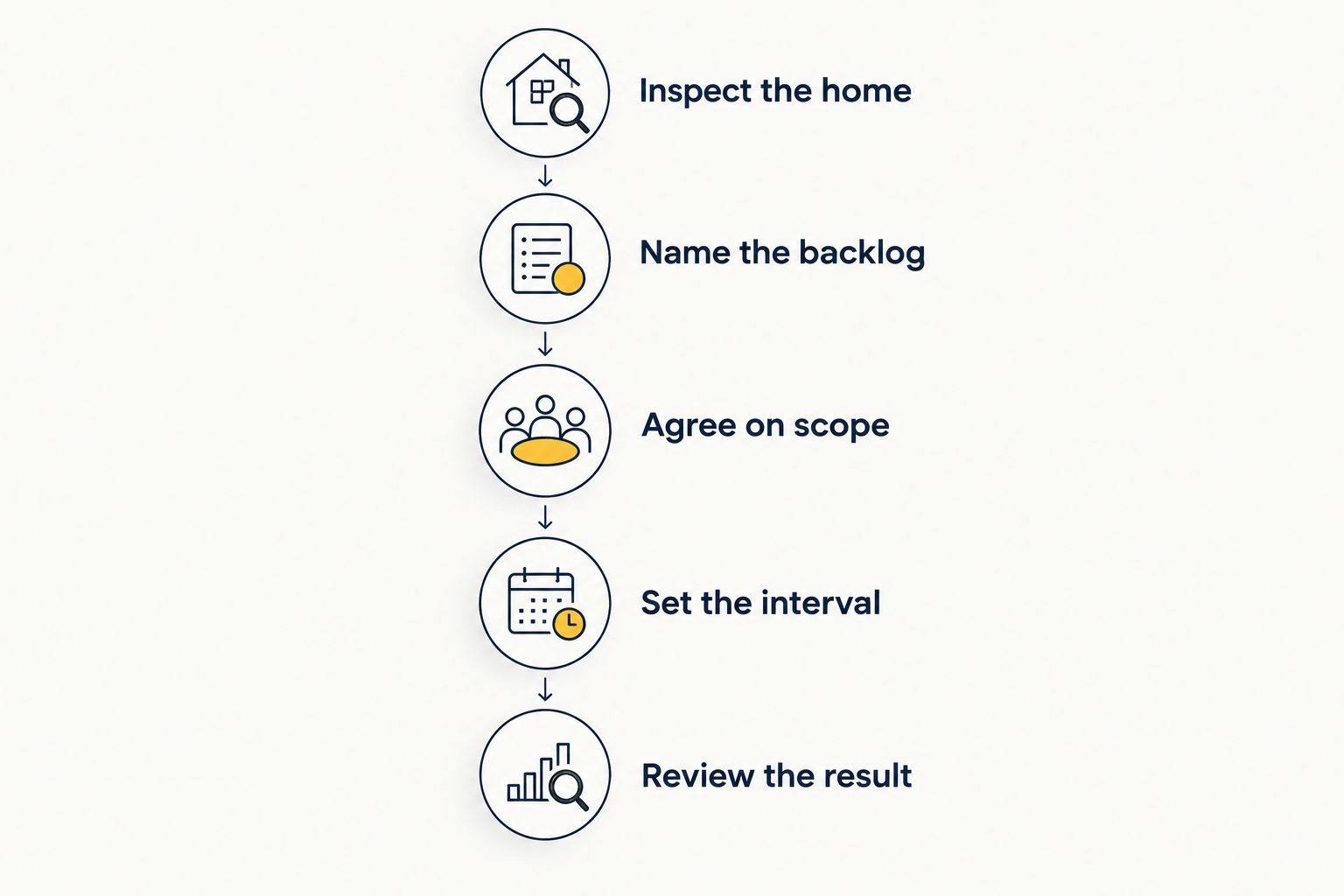
Agree on the work before setting the recurring interval.
Keep the brief short enough to use during the booking conversation. Photographs can help you describe a particular area, but ask the provider how they assess the work rather than assuming a photograph settles the scope.
What should you confirm before booking?
The distinction between maintenance and detailed work only helps when it appears in the booking agreement. When choosing between standard and deep cleaning, match each problem area to a named task; otherwise, the service label leaves the actual work unclear.
Ask direct questions:
- Which rooms and surfaces are included?
- Which tasks need a separate agreement?
- Should cupboards be emptied or belongings moved beforehand?
- Does the booking include cleaning inside appliances, or only outside surfaces?
- What happens if the condition differs from the description?
- How are unfinished priorities handled?
Housekept home cleaning is best for households seeking professional cleaning in Sydney, Shoalhaven or Illawarra. Review the cleaning services and confirm your required tasks before booking; location coverage alone does not establish the scope of an individual visit.
A professional booking gives you help with agreed work. It does not remove the need to explain access, priorities or exclusions. Keep a copy of the confirmed task list so you can review the result against the same brief.
Can regular cleaning replace a deep clean?
Regular cleaning replaces deeper catch-up work only when the required tasks actually get done. Increasing visit frequency while repeating the same narrow list leaves excluded areas excluded.
You can discuss rotating detailed tasks alongside routine maintenance. The advantage is that neglected detail receives planned attention; the limitation is that the cleaner must agree on how that work fits alongside essential tasks.
If a bathroom needs attention during every visit, do not quietly trade that work for cupboard interiors. Agree on priorities explicitly. Use your 2026 cleaning plan to record both recurring tasks and any separately scheduled detailed work.
Do you need a deep clean before starting regular visits?
A deep clean is a practical starting point when accumulated grime prevents a routine maintenance brief from matching the home's condition. It is not automatically necessary when the home is already maintained and the requested work is straightforward.
Ask the provider to assess the starting condition. Describe areas you have not cleaned recently and any surfaces requiring particular care, rather than choosing the least detailed option and expecting catch-up work within it.
The aim is a clear handover from initial work to maintenance. Record what the first appointment covers and what later visits will maintain.
Should every room follow the same schedule?
Set priorities by room condition, not symmetry. A frequently used kitchen and an unused spare room do not need identical attention simply because both appear on the floor plan.
Keep essential routine work visible in the brief, then identify less frequent detail separately. This avoids treating every appointment as a whole-home reset while allowing neglected areas to receive planned attention.
Review the arrangement when household use changes. Working from home, visitors or a change in what you can manage yourself are reasons to reassess the task list, not automatic instructions to book a particular package.
FAQ
How often should I book a deep clean versus a regular clean?
Book regular cleaning around everyday maintenance needs and deep cleaning around accumulated grime or neglected tasks. Weekly and fortnightly visits are scheduling options, not universal requirements; inspect the home and agree on the scope.
Is a fortnightly clean enough for my home?
A fortnightly clean fits when your home stays manageable between appointments and you can handle immediate cleaning yourself. If dirt repeatedly builds up before the next visit, review the interval or the task list.
Should I book a deep clean every season?
A seasonal reminder is a prompt to inspect your home, not proof that it needs a deep clean. Book the detailed work you identify rather than assuming every room needs the same treatment.
Does a deep clean include the oven and windows?
A deep-clean label does not establish whether oven interiors or windows are included. Ask the provider to confirm those tasks explicitly before booking.
Can I request detailed work during a regular clean?
You can ask to include detailed work, but the provider must agree on the changed scope and priorities. Do not assume extra tasks fit into an unchanged maintenance booking.
Do I need to tidy before the cleaner arrives?
Clear the surfaces you want cleaned unless tidying is explicitly included in the agreement. Tell the provider about access restrictions and ask before moving heavy furniture.
Does Housekept provide home cleaning in my area?
Housekept provides professional home cleaning across Sydney, Shoalhaven and Illawarra. Confirm coverage for your address and discuss the tasks required before booking.
One last thing
Before you add another booking to your 2026 calendar, name the task that keeps getting missed. If the same dirty area survives every visit, check the scope before increasing the frequency. More appointments only solve the problem when the required work is included.