
How often should lawns be mowed in Sydney?

Mow your Sydney lawn when new growth warrants a cut, rather than on the same day every week: in 2026, grass height and growing conditions remain better guides than a fixed calendar. Allow shorter gaps during active growth and longer gaps when growth slows, and avoid removing more than one-third of the grass blade in a single mow.
TL;DR
- How often should lawns be mowed in Sydney? Follow grass growth, not an unchanging weekly schedule.
- Remove no more than one-third of the grass blade in a single mow.
- Wait when grass is wet, soil is soft or the lawn shows drought stress.
- Housekept provides lawn maintenance services for households and businesses across Sydney, Shoalhaven and Illawarra.
Why this matters
A tidy lawn needs the right cut, not simply more cuts. Leaving actively growing grass too long makes the next mow harder to manage without cutting away too much leaf. Cutting a slow-growing or stressed lawn just because a booking is due creates a different problem: unnecessary disturbance.
Your 2026 maintenance plan should separate checking the lawn from actually mowing it. A regular reminder is useful; an automatic instruction to cut regardless of conditions is not. For rental properties, the lawn maintenance guide for landlords helps put mowing into the broader property-care routine.
How often should lawns be mowed in Sydney?
Mow when the lawn reaches its cutting threshold and conditions allow a clean cut. Sydney lawns do not share one correct interval: grass variety, sunlight, moisture and the height you maintain all affect how quickly that threshold arrives.
Use the one-third rule to decide whether a cut is due. Keep at least two-thirds of the existing blade rather than taking an overgrown lawn straight back to a short finish. This is a mowing guide, not a reason to cut grass that has barely grown.
Growth-led mowing
- Best for: Matching maintenance to the lawn
- Main benefit: Adjusts to actual growth and weather
- Main drawback: Requires checking the grass between cuts
Fixed-calendar mowing
- Best for: Organising reminders and access
- Main benefit: Makes property maintenance easier to plan
- Main drawback: The planned day does not always suit the lawn
Inspection-led mowing
- Best for: Preparing a rental property for a check
- Main benefit: Connects garden presentation to an upcoming deadline
- Main drawback: Waiting until the deadline can leave too much growth to remove safely
Use a calendar to organise the work, then let the lawn determine whether the work should happen. An inspection date or recurring reminder should not override saturated ground, drought stress or a lack of new growth.
What does the one-third rule mean in practice?
If you maintain a suitable grass variety at 40 mm, the one-third rule puts its cutting threshold at 60 mm. Removing 20 mm from a 60 mm blade leaves 40 mm behind. These figures illustrate the rule; they are not a recommended cutting height for every Sydney lawn.
Choose the maintained height for your grass variety and site first. A mower setting that suits one lawn is not automatically right for another, particularly where shade, uneven ground or an unfamiliar turf variety changes the job.
Active growth: shorten the gap between cuts
During active growth, check the lawn more closely and bring the next mow forward when the grass reaches its cutting threshold. Warmth and adequate moisture support growth in common warm-season lawns, so a schedule that worked during a quieter period can fall behind.
The advantage of timely cuts is straightforward: you remove a manageable amount of leaf instead of tackling an overgrown lawn. The limitation is the extra attention required. A fast-growing lawn needs more frequent assessment, even if you usually prefer a set-and-forget routine.
Look across the whole area before deciding. Open, sunny sections and sheltered patches do not always grow evenly. Base the cut on the grass that needs attention without repeatedly cutting already-short areas lower.
Bring the mow forward because of growth, not because the lawn looks untidy in one isolated patch. Check whether that patch is grass, a weed or growth missed during the previous cut.
Slower growth: extend the gap between cuts
When growth slows, leave more time between mowing sessions. A lawn that remains near its maintained height does not need another cut simply because the usual appointment has arrived.
Extending the interval avoids unnecessary mowing, but it does not mean abandoning the garden. Leaves, fallen branches, weeds and untidy edges still need attention. Keep those tasks separate from the decision to shorten the grass.
Cooler conditions commonly slow warm-season turf, while shade and limited moisture also affect growth. Check the lawn itself rather than assuming that every part of Sydney follows an identical seasonal pattern.
For your 2026 seasonal plan, write down conditions rather than rigid promises: active growth means closer checks; little growth means a longer gap. That instruction remains useful when the weather does not match the calendar.
Wet or stressed lawns: wait for suitable conditions
Postpone mowing when the grass is wet or the ground is too soft to support the mower without damage. Wet clippings clump, and mower wheels can mark soft ground. A break in the rain does not necessarily mean the soil underneath is ready.
Check the surface before starting. If walking leaves obvious impressions or the mower sinks into the ground, wait. Avoid treating a deadline as permission to make ruts that will remain after the lawn dries.
Drought-stressed grass also needs a different response from vigorously growing grass. Do not cut a struggling lawn shorter to stretch the time before the next visit. Reduce unnecessary stress and reassess the maintained height for the grass variety and conditions.
Waiting has a trade-off: the garden stays less tidy for longer. That is preferable to forcing a cut when the lawn cannot support it. Rearrange the work around the lawn, rather than making the lawn fit the appointment.
Why lawn-mowing frequency varies in Sydney
These factors explain why neighbouring properties can need different mowing routines. Use them to adjust your own schedule, not to copy someone else's.
- Grass variety: Different turf varieties have different growth habits and preferred cutting heights. Identify yours before choosing a maintained height.
- Season and temperature: Active warm-season growth needs a different approach from periods when that growth slows. Review the interval as conditions change.
- Rainfall and watering: Moisture affects growth, while saturated ground affects whether mowing is practical. Faster growth and suitable mowing conditions are separate questions.
- Sunlight and shade: Sunny and shaded areas can grow differently within the same garden. Check both rather than judging the whole lawn from the fastest-growing section.
- Fertiliser use: Feeding affects growth. Reassess mowing needs after fertilising instead of assuming the previous interval still fits.
- Maintained height: Your chosen cutting height determines when the one-third threshold is reached. Cutting very short is not a substitute for appropriate scheduling.
Foot traffic matters when assessing lawn condition, too. A worn patch does not need repeated cutting simply because surrounding grass is growing. Look at both height and condition before sending the mower across it.
How do I set a mowing routine that fits my lawn?
Build your 2026 routine around a repeatable check. The aim is to make a clear decision before starting the mower, not to create a complicated garden record.
- Identify the grass. Confirm the turf variety before choosing a cutting height. If you cannot identify it, seek advice rather than copying a neighbour's mower setting.
- Set the height. Choose a maintained height suited to that variety and the site. Account for shade and uneven ground rather than aiming for the shortest possible finish.
- Check the growth. Compare the current grass height with your maintained height. Use the one-third rule to judge when mowing is due.
- Check the ground. Look for wet blades, soft soil and signs of stress. A lawn can need shortening without being ready to mow that day.
- Adjust the schedule. After the cut, note whether growth was easy to manage or had already become excessive. Bring the next check forward or leave a longer gap accordingly.
Keep the record simple: date, lawn condition and whether you cut or waited. Those observations are more useful than repeatedly guessing why the same booking interval works at one time of year but not another.
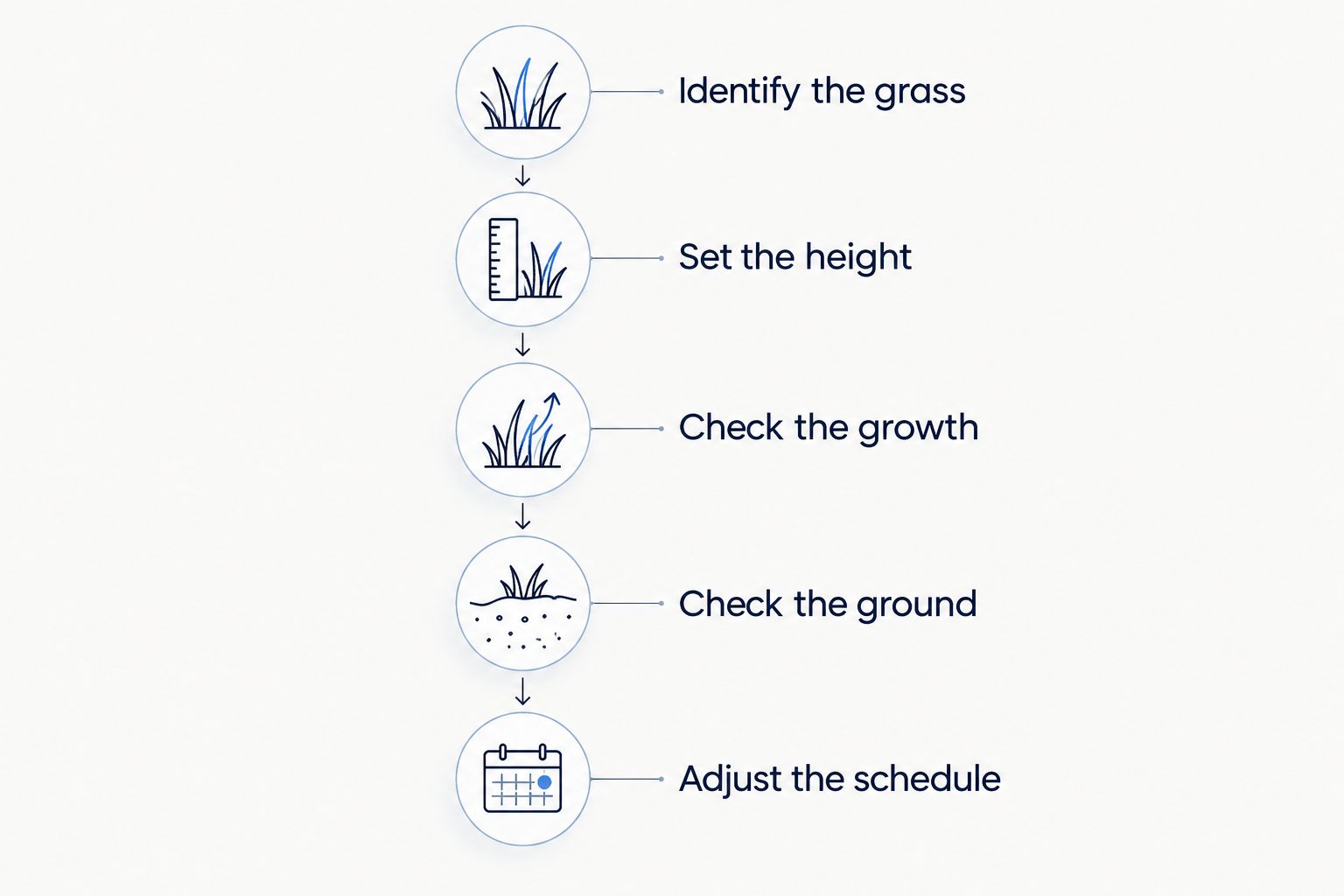
Check growth and ground conditions before committing to the next cut.
Should I mow an overgrown lawn shorter to catch up?
The one-third rule still applies when the lawn is overgrown. Raise the cutting height for the first cut instead of taking the grass straight back to your usual finish. Return towards the maintained height gradually, allowing the lawn to recover between cuts.
A very low catch-up cut removes more leaf at once and increases the risk of scalping. It also fails to solve the scheduling problem: if the grass is actively growing, it will still need ongoing attention.
Check the area for hidden objects before mowing long grass. Clear branches, toys and other obstacles, and inspect the ground rather than pushing through an unfamiliar patch. If the job exceeds what your equipment can handle safely, arrange help.
Is regular mowing better than mowing before an inspection?
The one-third rule makes regular assessment more useful than a last-minute tidy-up. Checking the lawn throughout the tenancy gives you a chance to mow before it becomes too long for a straightforward cut.
An inspection reminder is still useful. Treat it as a prompt to assess grass height, edges and access, not as the first time anyone looks at the garden. Wet weather near the inspection can also remove the opportunity to mow safely.
Keep responsibility clear between the people managing and occupying the property. Confirm who checks the lawn, who arranges the work and who communicates weather-related changes. Do not assume that a booking alone covers those decisions.
When should I arrange professional lawn maintenance?
Arrange help when you cannot consistently check growth, operate the equipment safely or fit the work around your other responsibilities. The benefit is having someone carry out the physical maintenance; you still need to communicate access, property boundaries and the result you want.
Housekept lawn maintenance is best suited to households and businesses seeking professional lawn care in Sydney, Shoalhaven or Illawarra. Housekept provides lawn maintenance alongside residential and commercial cleaning services. You can review the available services when planning care for your property.
The trade-off with a fixed service arrangement is that grass and weather do not follow booking dates. When discussing Housekept lawn maintenance, ask how the proposed schedule accounts for changing growth and unsuitable ground conditions. Confirm the scope rather than assuming mowing includes every garden task.
Give the provider useful information: whether the lawn is overgrown, whether access is restricted and whether obstacles need clearing. Clear instructions support a practical plan without asking anyone to guess what the property needs.
FAQ
Should I mow my Sydney lawn every week?
A weekly reminder is useful, but a weekly cut is not automatically necessary. Mow according to grass growth, the maintained height and ground conditions rather than cutting regardless of what the lawn needs.
How often should I mow my lawn during summer in Sydney?
Mow when active growth brings the lawn to its cutting threshold, while removing no more than one-third of the blade. Warm conditions and adequate moisture can shorten the gap, but your grass variety and site still determine the routine.
Does my lawn need mowing during winter in Sydney?
Mow during winter only when the lawn has grown enough to need a cut and conditions are suitable. Warm-season grass commonly grows more slowly in cooler conditions, so extend the gap rather than keeping an unchanged summer schedule.
Can I mow my lawn straight after rain?
Wait until the grass is dry enough for a clean cut and the ground supports the mower without rutting. Rain stopping does not mean soft soil is ready for mowing.
How much grass should I remove when I mow?
Remove no more than one-third of the grass blade in a single mow. For example, cutting a 60 mm blade to 40 mm removes 20 mm; that illustrates the rule rather than prescribing a height for every turf variety.
Will cutting my lawn shorter mean I can mow less often?
Cutting below a suitable maintained height is not a sound way to reduce mowing frequency. It increases the risk of scalping and does not address the lawn's underlying growth rate.
What should I tell a lawn maintenance provider before booking?
Tell the provider about grass condition, access restrictions, obstacles and the work you want included. Ask how growth changes and wet ground affect the proposed mowing schedule.
One last thing
Put a lawn check in your calendar, not an unconditional mow. That small distinction gives you permission to wait when the ground is wet and act sooner when growth accelerates.
For the rest of 2026, judge the routine by what it leaves behind: an even cut, sufficient leaf and ground without mower damage. A neat calendar is not the goal. A well-maintained lawn is.