
How much does house cleaning cost in Sydney in 2026?

House cleaning in Sydney needs a property-specific quote: compare the total for an agreed task list, not an hourly figure alone. For your 2026 booking, confirm the treatment of extra tasks, supplies and access arrangements before you agree to the work.
TL;DR
- How much does house cleaning cost in Sydney? Compare written totals for the same rooms, tasks and visit frequency.
- Housekept provides house cleaning for Sydney households; confirm the scope before booking.
- Choose hourly cleaning for prioritised tasks or a fixed-scope quote for a defined checklist.
- Keep regular cleaning, detailed cleaning and end-of-lease cleaning separate when comparing quotes.
Why this matters
A cleaning quote only makes sense beside its task list. A booking focused on bathroom surfaces and floors is not equivalent to one that also covers appliance interiors, window tracks and detailed skirting-board work.
Housekept house cleaning is a fit for Sydney households seeking a professional home-cleaning service. Start with Housekept, then ask for a written scope that matches your home rather than assuming every cleaning task belongs in the booking.
Use this guide to compare 2026 quotes, describe the work clearly and avoid choosing a service that leaves your main priorities unfinished.
How much does house cleaning cost in Sydney in 2026?
The actionable figure is the quoted total for your property and agreed work. Ask providers to state whether the booking covers a defined checklist or a block of cleaning time, then compare equivalent work.
Start by separating the billing arrangement from the type of clean. An hourly booking describes how time is charged; regular, detailed and end-of-lease cleaning describe the purpose and scope of the work.
Hourly booking
- Best for: A prioritised task list
- Main benefit: Lets you direct attention to the work that matters most
- Main limitation: A time limit does not guarantee every task is finished
- What to confirm: Total cleaner-hours, priorities and approval for extra time
Fixed-scope booking
- Best for: A defined cleaning checklist
- Main benefit: Makes the agreed deliverables explicit
- Main limitation: Work outside the checklist needs separate agreement
- What to confirm: Inclusions, exclusions and change approval
Regular house cleaning
- Best for: Ongoing household upkeep
- Main benefit: Gives recurring tasks a consistent place in your routine
- Main limitation: Detailed restoration work needs its own scope
- What to confirm: Repeat checklist and treatment of occasional tasks
Detailed clean
- Best for: Addressing accumulated grime or neglected areas
- Main benefit: Focuses the booking on more intensive tasks
- Main limitation: The label alone does not specify what gets cleaned
- What to confirm: Surfaces, condition and detailed tasks
End-of-lease cleaning
- Best for: Preparing a property for handover
- Main benefit: Connects the work to a move-out checklist
- Main limitation: It is not interchangeable with an ordinary maintenance clean
- What to confirm: Inspection requirements and specialist work
For a 2026 comparison, send each provider the same description. Different instructions produce different offers, even when the property address is identical.
Hourly cleaning: agree on priorities and cleaner-hours
An hourly arrangement suits you when some tasks matter more than others and you accept that the booking has a time boundary. Put the essential work first. Ask what happens if the cleaner reaches the agreed limit before finishing the list.
Distinguish time on site from total cleaner-hours. A team booking and a solo booking are not directly comparable unless the quote explains the staffing and total work time.
Before accepting, ask:
- Does the quoted time mean elapsed time or total cleaner-hours?
- Which tasks should the cleaner complete first?
- Who approves additional work time?
- What happens to tasks left unfinished?
Choose hourly cleaning for a controlled priority list, not an assumed whole-house result. Its flexibility is useful, but only when the stopping point is clear.
Fixed-scope cleaning: define what completion means
A fixed-scope arrangement suits you when you want agreement on specific deliverables. The checklist matters more than the booking label. Ask for rooms, surfaces and exclusions in writing.
Describe unusual conditions before accepting the quote. Heavy grease, extensive clutter or difficult access should not become a discussion only after the cleaner arrives.
The advantage is a defined result. The limitation is that a checklist can omit something you consider essential, so read it against your own priorities rather than treating it as a complete description of every possible cleaning task.
Regular house cleaning: separate upkeep from catch-up work
Regular cleaning suits households that want ongoing help with agreed maintenance tasks. Decide what belongs in every visit and what needs a separate discussion. A recurring booking should not depend on a fresh set of verbal instructions each time.
For your 2026 routine, identify the rooms that need consistent attention and the tasks you handle yourself. If your main concern is bathroom upkeep, say that explicitly rather than asking for a general tidy.
The benefit is a repeatable brief. The limitation is that a maintenance checklist does not automatically cover accumulated grime, appliance interiors or detailed work throughout the home.
Detailed cleaning: name the surfaces, not just the service
A detailed clean suits you when the work goes beyond your ordinary upkeep list. Replace broad phrases such as deep clean with specific instructions. For example, distinguish wiping cupboard fronts from cleaning empty cupboard interiors.
Describe the condition as well as the surface. Routine wiping and removing established build-up are different jobs, even in the same room.
A detailed scope directs attention to neglected areas, but it still needs boundaries. Ask about surface suitability and specialist work rather than assuming stronger products or more scrubbing are appropriate everywhere.
End-of-lease cleaning: quote against the handover requirements
End-of-lease cleaning suits renters preparing for property handover. Start with the relevant inspection checklist, then identify which items require cleaning and which concern maintenance, damage or another trade.
Do not compare a handover-focused booking with a basic home-cleaning visit as though the task lists were identical. Read the Sydney end-of-lease cleaning cost guide when your booking is tied to moving out.
The benefit is a scope built around the handover. The limitation is that cleaning cannot resolve every inspection issue, and no assumed outcome should replace written service terms.
Why house cleaning quotes vary
The work you request determines whether quotes are comparable. Use these factors to explain your home clearly rather than asking providers to interpret a short bedroom count.
- Rooms and surfaces: List bathrooms, living areas, stairs and floor types so the brief describes the actual work.
- Starting condition: Identify grease, soap scum, dust build-up and other areas needing particular attention.
- Task depth: Separate exposed-surface cleaning from interiors, edges, tracks and other detailed work.
- Visit frequency: State whether you want a one-off visit or recurring upkeep, and describe the expected repeat checklist.
- Access and preparation: Explain entry arrangements, parking instructions, clutter and areas that must remain untouched.
- Equipment and exclusions: Ask who supplies products and equipment, and which requested tasks sit outside the service.
Use the same brief for every provider. A comparison built on different assumptions tells you little about which booking meets your needs.
How do you get a house cleaning quote you can compare?
Prepare one written brief before requesting quotes. Keep it short enough to read quickly, but specific enough that the provider can identify the work and ask sensible follow-up questions.
- Describe the home. List the rooms, bathrooms, stairs and relevant surface types. Identify spaces you do not want included.
- List the tasks. Separate essential work from optional work. State whether interiors, detailed edges or appliance cleaning form part of the request.
- Show the condition. Describe build-up and problem areas accurately. Provide photographs if requested, avoiding personal documents and identifying information.
- Confirm the scope. Ask for the total, inclusions, exclusions and process for approving changes before accepting.
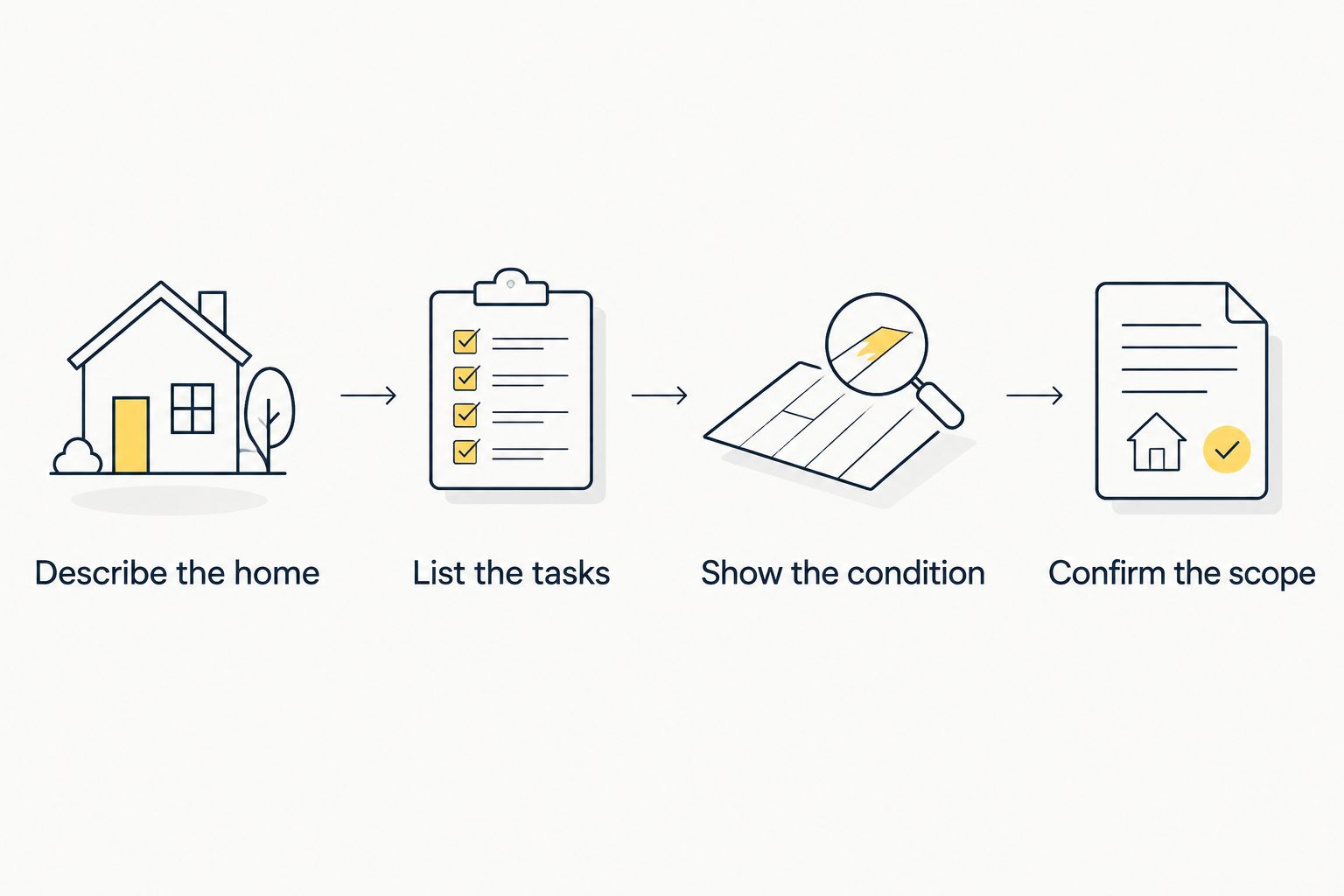
Agree on the tasks and condition before comparing the quoted totals.
Keep the accepted brief with the booking confirmation. If your requirements change, update the scope before the visit rather than relying on a conversation at the door.
Prepare your home without doing the cleaner's job
Preparation should make the agreed surfaces accessible. It should not turn into completing the cleaning yourself. Move personal paperwork, secure valuables and identify anything the cleaner should not handle.
If clutter prevents access to benches or floors, treat decluttering your home as a separate preparation task, not an assumed part of the cleaning booking. Sorting belongings requires decisions about what stays, moves or leaves; cleaning the exposed surface is a different job.
Be clear about this boundary in your 2026 booking brief. If you need help moving or organising belongings, ask whether that work is included before the visit.
Also provide practical access instructions. Explain keys, entry codes and pets through the provider's agreed communication process, and avoid putting sensitive access details into a public enquiry.
How do you compare quotes without choosing the wrong scope?
Compare the work first and the total second. Put each quote beside your original brief and mark any task that is excluded, unclear or described differently. Resolve those differences before choosing.
A short comparison checklist helps:
- Same rooms: Does every quote cover the spaces you requested?
- Same depth: Does each provider distinguish routine wiping from detailed work?
- Same responsibility: Are supplies, equipment and preparation requirements clear?
- Same approval process: Must you approve changes before additional work proceeds?
- Same endpoint: Is completion defined by time, tasks or another written agreement?
Do not assume the longer checklist is automatically the better fit. Work you do not need is not a substitute for the bathroom, kitchen or floor priorities you actually want completed.
For 2026 bookings, keep a copy of the final agreed scope rather than relying on an earlier enquiry. The accepted version is the useful reference when you discuss what was included.
Is regular cleaning better than a one-off clean?
Regular cleaning is better for ongoing upkeep; a one-off clean is better for a defined, occasional task list. Neither arrangement is automatically right for every home. Choose based on what you need repeated and what needs attention only now.
If the first visit involves catch-up work, ask how its scope differs from later visits. Do not assume the first booking and the repeat booking cover identical tasks.
Does house cleaning include ovens and windows?
House cleaning includes ovens and windows only when the agreed scope says so. Name the exact task: an oven exterior is different from its interior, and accessible internal glass is different from exterior window work.
Ask about access and surface restrictions as well as inclusion. A broad room label does not settle every task within that room.
Can you reduce the booking scope without losing the main benefit?
You can reduce the scope by removing lower-priority tasks while keeping your essential work explicit. Start with the areas you need cleaned most, then identify what you can handle yourself or defer.
Do not simply request less time without changing the task list. A shorter booking and an unchanged expectation create a mismatch rather than a clear saving decision.
FAQ
How much does house cleaning cost in Sydney in 2026?
Use a property-specific written quote for the rooms, condition and tasks you need cleaned. Compare the total alongside inclusions and exclusions rather than treating an hourly figure as the whole booking.
Is hourly or fixed-scope house cleaning better?
Hourly cleaning suits a prioritised task list, while fixed-scope cleaning suits defined deliverables. Confirm the time boundary for hourly work and the completion checklist for fixed-scope work.
What should I tell a cleaner before asking for a quote?
Describe the rooms, surfaces, starting condition and tasks you want completed. Include access arrangements, visit frequency and anything the cleaner must not move or touch.
Does a regular clean include a deep clean?
A regular clean includes detailed work only when that work appears in the agreed scope. Specify interiors, tracks, edges and accumulated build-up rather than relying on the phrase deep clean.
Should I tidy before a house cleaner arrives?
Clear access to the surfaces covered by your booking and secure personal items. Ask separately about organising or moving belongings instead of assuming those tasks are included.
Does Housekept provide house cleaning in Sydney?
Housekept provides professional home-cleaning services for Sydney households. Request a quote that identifies your rooms, cleaning priorities and required scope.
Can I use a regular house clean for an end-of-lease inspection?
Use a scope that matches the handover requirements rather than assuming a regular clean covers them. Separate cleaning tasks from damage, repairs and specialist work.
One last thing
Ask what will remain uncleaned, not just what will be cleaned. That question exposes scope gaps before the booking. A clear exclusion gives you something to plan around; an unstated assumption leaves your priority task unresolved.