.png)
Best cleaning caddies and supply kits for professional cleaners 2026

Best overall: a rigid divided cleaning caddy. Best for moving between rooms: a wearable cleaning caddy. Best simple supply kit: a bucket with a removable organiser. This 2026 guide ranks the best cleaning caddy formats for professional cleaners by access, separation, portability and ease of cleaning—not by how many bottles you can squeeze inside.
TL;DR
- The best cleaning caddy for routine professional cleaning is a rigid divided caddy with accessible compartments.
- Choose a wearable cleaning caddy for room-to-room work; keep bulk supplies in a separate kit.
- Use a cleaning trolley for supplies travelling together on an accessible, mostly level route.
- Housekept suits households and businesses seeking professional cleaning services across Sydney, Shoalhaven and Illawarra.
Why this matters
A cleaning caddy should keep the supplies for your current task within reach. A container that buries cloths under bottles creates another job: unpacking before you can start cleaning.
This guide separates portable organisers from full supply transport. If you want the cleaning handled rather than another kit to manage, Housekept provides residential and commercial cleaning services across Sydney, Shoalhaven and Illawarra.
For professional cleaners choosing equipment in 2026, the practical question is simple: what needs to travel with you, and what should stay in the main supply kit? Start there before comparing handles, pockets or accessories.
What makes the best cleaning caddy?
Judge each format against these criteria before choosing a particular model:
- Accessible supplies: You can remove a cloth, brush or bottle without shifting everything else. Check access with your actual supplies inside.
- Useful separation: Compartments keep bottles upright and give clean cloths their own space. Used cloths need a separate collection container.
- Comfortable transport: The loaded handle, strap or trolley suits the route between storage and the work area. Assess the full kit, not the empty container.
- Easy cleaning: You can reach the base, corners and compartments to remove residue. Fabric organisers need a cleaning method appropriate to their material.
- Task fit: The organiser holds what the job requires without becoming your entire stockroom. Deep-cleaning equipment belongs in a separate task kit when it crowds routine supplies.
- Safe storage: Labels remain readable and containers stay secure. A caddy organises chemicals; it does not replace label instructions or suitable chemical storage.
Cleaning caddies at a glance
These recommendations compare five organiser formats. Individual models differ, so inspect the construction and test the fit before choosing one.
1. Rigid divided caddy
- Best for: Routine residential cleaning
- Standout feature: Open access with defined compartments
- Key limitation: Carries supplies in one hand
2. Wearable cleaning caddy
- Best for: Moving between rooms
- Standout feature: Small tools remain on your body
- Key limitation: Weight sits on your waist or shoulders
3. Bucket with removable organiser
- Best for: A compact, simple task kit
- Standout feature: Combines a bucket and organised storage
- Key limitation: The insert needs somewhere to sit during bucket use
4. Zipped cleaning tool bag
- Best for: Transporting dry tools between jobs
- Standout feature: Enclosed pockets contain loose equipment
- Key limitation: Interior fabric is less straightforward to wipe clean
5. Cleaning trolley
- Best for: Moving a larger kit along accessible routes
- Standout feature: Supplies travel together without hand-carrying the whole kit
- Key limitation: Stairs and tight spaces interrupt its use
1. Rigid divided caddy: best cleaning caddy for routine jobs
A rigid divided caddy is an open container with a handle and separate storage sections. Choose a layout that gives bottles a stable position and leaves cloths and hand tools visible. It is the default recommendation for routine professional cleaning in 2026.
The useful feature is separation, not maximum capacity. A wide compartment that accepts your spray bottle is more valuable than several narrow slots that force you to rearrange the kit.
Rigid divided caddy pros:
- Open storage makes the contents visible during work.
- Defined sections keep tools from collecting in one pile.
- Accessible hard surfaces make residue easier to remove.
- A freestanding design gives the kit a place to sit while you work.
Rigid divided caddy cons:
- Carrying it occupies a hand between work areas.
- An open top leaves contents exposed during transport.
- Fixed compartments restrict which containers fit.
Best for: Cleaners carrying a focused set of bottles, cloths and brushes into homes or individual work areas.
Before choosing, load the intended bottles and grip the handle. Check that bottle triggers do not collide with it, that the caddy sits flat, and that you can reach the smallest tool without unpacking.
Verdict: Buy a rigid divided caddy as your default portable organiser.
2. Wearable cleaning caddy: best for room-to-room work
A wearable cleaning caddy uses an apron, belt or shoulder arrangement to carry small supplies. Its strength is keeping frequently used tools with you while you move, rather than carrying the entire cleaning kit on your body.
Choose pockets around the tools you actually reach for. A cloth pocket, a brush pocket and a secure place for a small container make more sense than loading every available space.
Wearable cleaning caddy pros:
- Keeps small tools close during movement between rooms.
- Leaves your hands free for carrying other equipment.
- Separates tools through dedicated pockets.
- Avoids repeatedly placing a portable container on the floor.
Wearable cleaning caddy cons:
- Loaded weight rests on your waist or shoulders.
- Bulky contents interfere with bending and close work.
- Fabric pockets require attention after spills or contact with used tools.
Best for: Cleaners who repeatedly move between rooms with a small, consistent tool set.
Treat a wearable organiser as a working layer, not a replacement for storage. Keep replacement cloths, larger bottles and specialist products in the main kit. Remove anything that presses against your body when you crouch or reach.
Verdict: Buy for mobile tasks; skip as your only supply kit.
3. Bucket organiser: best for a compact, simple cleaning kit
A bucket with a removable organiser combines a working bucket with storage for small supplies. This format suits a task that genuinely needs a bucket; the organiser comes out when the bucket is put to work.
If you already use a suitable bucket, assess an insert against its dimensions and handle clearance. The important test is whether the loaded organiser lifts out cleanly without tipping bottles or catching the bucket handle.
Bucket organiser pros:
- Keeps a bucket and its associated tools together.
- A removable insert gives small supplies defined spaces.
- The bucket provides a rigid outer container for transport.
- The format supports a focused task kit rather than scattered equipment.
Bucket organiser cons:
- The loaded insert needs a separate resting place during bucket use.
- Insert fit depends on the particular bucket.
- Returning a wet bucket to storage adds a drying step.
Best for: Cleaners building a compact kit around a task that already requires a bucket.
Do not choose this format merely because a bucket holds plenty. If your routine relies on spray bottles and dry cloths, an open divided caddy avoids the extra step of removing an insert.
Verdict: Buy when the bucket has a job; skip when it is only extra packaging.
4. Zipped tool bag: best for carrying dry cleaning tools
A zipped cleaning tool bag encloses brushes, pads and other dry equipment during transport. Pockets give small items a home, while the closure contains loose tools that would otherwise sit exposed in an open caddy.
Its best role is transport between jobs. Check pocket access with the bag open, and keep wet cloths or leaking containers out of fabric compartments unless the bag is specifically designed for that use.
Zipped cleaning tool bag pros:
- Encloses loose tools during transport.
- Pockets separate small brushes and accessories.
- A closed bag keeps the contents contained when moved.
- Provides a dedicated place for dry task equipment.
Zipped cleaning tool bag cons:
- Opening and closing adds a step during repeated access.
- Fabric interiors are less straightforward to wipe than open hard surfaces.
- Deep pockets conceal small items.
Best for: Cleaners transporting a separate collection of dry tools between properties.
Avoid treating a tool bag as an unrestricted chemical carrier. Check the manufacturer's intended use and cleaning instructions. Keep labels readable and follow the storage requirements of every product you carry.
Verdict: Buy for dry-tool transport; skip as the default wet working caddy.
5. Cleaning trolley: best for larger kits on accessible routes
A cleaning trolley moves supplies on wheels instead of requiring you to hand-carry the whole kit. It fits work where multiple supplies need to travel together along a route the trolley can actually follow.
For a 2026 equipment decision, assess the building before the trolley. Doorways, storage space, lifts, steps and turning areas determine whether it belongs in the workflow.
Cleaning trolley pros:
- Moves a larger supply kit together.
- Shelves and holders create separate storage areas.
- Reduces the need to hand-carry the complete kit along suitable routes.
- Provides a mobile base for replacement supplies.
Cleaning trolley cons:
- Stairs interrupt the trolley route.
- Tight rooms and narrow access restrict movement.
- Wheels, shelves and holders add cleaning and storage requirements.
Best for: Larger workplaces or properties with accessible routes between work areas.
A trolley and a portable caddy serve different purposes. Keep the main supplies on the trolley, then carry a small task kit into a room when wheeling the whole unit inside would obstruct work.
Verdict: Buy for an accessible larger site; skip for stair-heavy room-to-room work.
Build a supply kit that stays organised
The best cleaning caddy cannot fix an overcrowded kit. Use 3 kit zones: Working supplies, Clean reserves and Used items. These are an organisation recommendation, not a claim about any product's capacity.
- Working supplies: Carry only the labelled products and tools needed for the current task. Keep containers upright and labels visible.
- Clean reserves: Store replacement cloths and spare supplies separately from used equipment. Bring them into the working kit when needed.
- Used items: Collect used cloths and pads in a separate suitable container. Do not put them back among clean supplies.
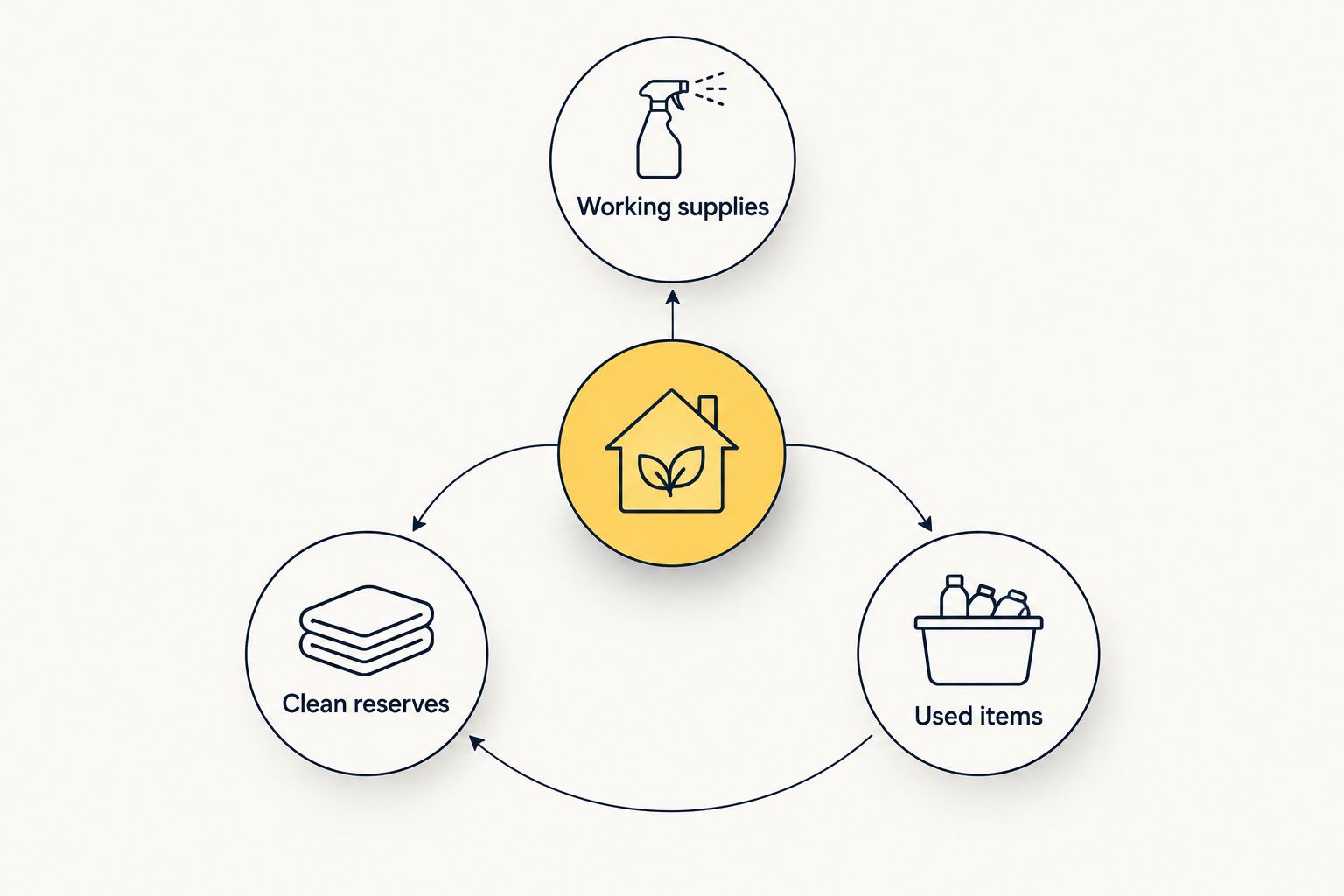
Separate used items from clean reserves instead of relying on extra pockets.
For cloth organisation, start with 2 cloth sets: one assigned to bathroom work and one assigned to other areas. Keep those assignments distinct during the job; a colour system only helps when everyone follows the same meaning.
Pack 1 task kit at a time rather than carrying every specialist product into every room. End-of-lease cleaning, holiday-rental turnovers and routine household cleaning need different preparation, even when they use the same organiser.
Check the loaded kit before your next job
Run a practical fit check before making the organiser part of your routine. Place it on a stable surface, remove each item in turn, and check that the remaining contents stay upright.
Then carry it along the intended route. Check your grip, door clearance and the space available to put the kit down. For a wearable organiser, include bending and reaching; for a trolley, include turns and thresholds.
Read chemical labels before deciding what shares a compartment. Never mix bleach with acids or ammonia. Do not decant products into unlabelled bottles, and follow the label's handling and storage instructions rather than assuming the organiser makes a combination safe.
How we ranked these cleaning caddies
This 2026 ranking prioritises accessible supplies, useful separation, comfortable transport, easy cleaning, task fit and safe storage. It compares organiser formats and their physical trade-offs, not individual product performance or laboratory results.
The rigid divided caddy takes the default position because it provides open access and defined sections without requiring a bucket, wearable arrangement or wheeled route. The other formats win when their particular use case matters more.
Which cleaning caddy should you choose?
Choose a rigid divided caddy unless your workflow gives you a clear reason not to. Pick a wearable organiser for frequent movement, a bucket insert for bucket-based work, a zipped bag for dry-tool transport, or a trolley for a larger accessible site.
Housekept provides professional cleaning services for households and businesses across Sydney, Shoalhaven and Illawarra. If your goal is a cleaned property rather than managing supplies yourself, choose the service route instead of expanding the equipment kit.
Choose professional cleaning
Residential and commercial cleaning across Sydney, Shoalhaven and Illawarra.
FAQ
What's the best cleaning caddy for professional cleaners in 2026?
A rigid divided cleaning caddy is the best default for routine professional cleaning. Its open layout and separate sections keep working supplies accessible; choose a different format when your route or task requires it.
Is a wearable cleaning caddy better than a handheld caddy?
A wearable cleaning caddy is better for keeping small tools with you between rooms. A handheld divided caddy is the better default when you need a freestanding organiser for bottles, cloths and brushes.
Should I choose a bucket organiser or a separate cleaning caddy?
Choose a bucket organiser when the cleaning task already needs a bucket. Choose a separate caddy when removing and setting down an insert would add an unnecessary step.
Can I keep clean and used cloths in the same caddy?
Keep used cloths in a separate suitable collection container, not among clean cloths. Extra compartments do not replace a clear separation process.
What should go in a professional cleaning supply kit?
Pack the labelled products, cloths and tools required for the current task. Keep clean replacements separate, collect used items separately and leave unrelated specialist supplies in the main storage kit.
Is a cleaning trolley suitable for houses with stairs?
A trolley is not the default choice for stair-heavy household cleaning because it cannot follow the complete route. A portable caddy carries the working supplies between levels while the larger stock stays separately stored.
Does Housekept provide cleaning services instead of cleaning equipment?
Housekept provides residential and commercial cleaning services across Sydney, Shoalhaven and Illawarra. Its stated services also include Airbnb and holiday-rental, end-of-lease, NDIS/DVA and lawn maintenance work.
One last thing
Before replacing your cleaning caddy in 2026, unpack it and remove everything unrelated to the next job. Repack the working supplies, then repeat the access and carrying checks. An overfilled kit needs editing before it needs a bigger container.