
DVA cleaning services for veterans: complete 2026 guide
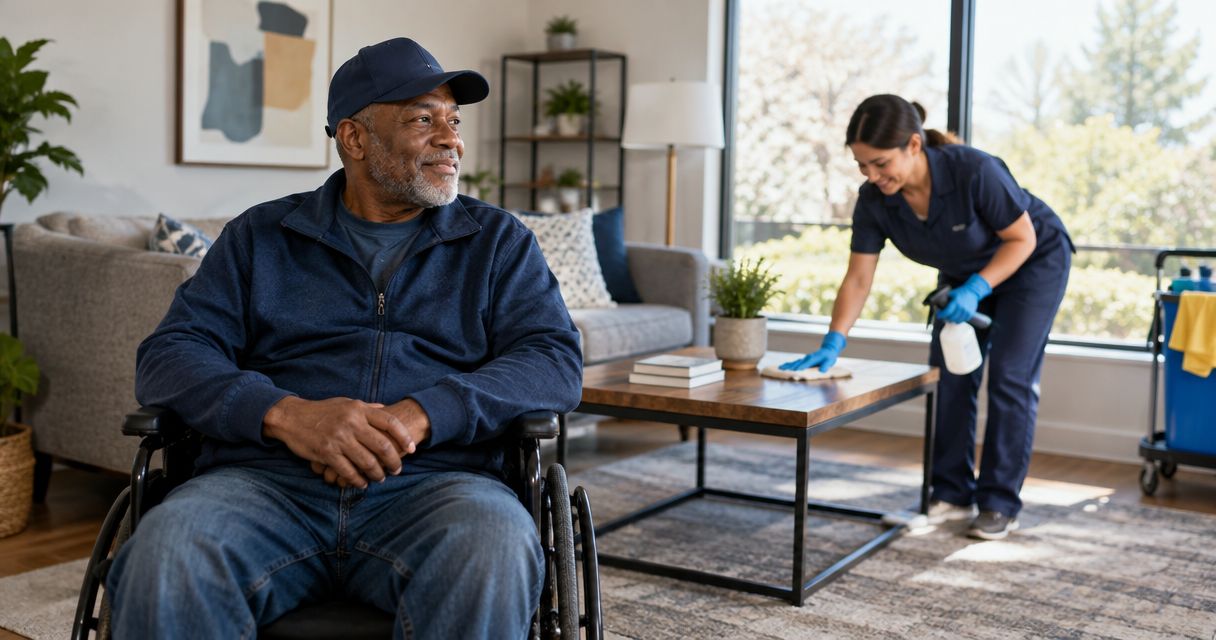
Veterans’ DVA cleaning services are domestic cleaning support arranged through an applicable Department of Veterans’ Affairs pathway, with the aim of helping veterans maintain a safe, manageable home. This 2026 guide explains how to check your pathway, agree on household tasks and choose a cleaner without confusing a service booking with funding approval.
TL;DR
- DVA cleaning services start with confirming your support pathway, not assuming a cleaning booking guarantees funding.
- Housekept provides DVA cleaning services across Sydney, Shoalhaven and Illawarra; confirm arrangements before booking.
- Agree on domestic assistance tasks, access instructions and communication needs before the first visit.
- Keep routine house cleaning separate from specialist work and tasks outside your approved arrangements.
Why DVA cleaning matters for veterans
Cleaning support needs to fit your abilities, your home and the assistance you are authorised to receive. A tidy-looking room does not tell a cleaner which movements cause pain, which areas you cannot safely reach or where you need help most.
For veterans managing an injury, illness or reduced mobility, the useful starting point is the task that has become difficult—not a standard cleaning package. Bathroom floors, vacuuming and changing bed linen involve different movements and access requirements.
Housekept is best for veterans seeking a local DVA cleaning service across Sydney, Shoalhaven and Illawarra. You can discuss your household requirements with Housekept, then confirm whether the proposed service fits your particular DVA arrangements before authorising work.
The distinction matters: a provider offering DVA cleaning does not establish your eligibility, approve your assistance or make every requested task part of your support. Keep those decisions separate throughout your 2026 planning.
How to arrange DVA cleaning services
Use this sequence to turn a general request for help into a clear cleaning brief. You can write the brief on paper or use a phone note; no paid planning tool is necessary.
List your needs
Start with a room-by-room list of tasks you cannot comfortably or safely complete. Describe the difficulty rather than supplying a medical history: reaching the shower floor, carrying a vacuum between levels or bending to change bedding gives the cleaner practical information.
Set aside 10 minutes for the first draft and choose 3 priority tasks. These are planning suggestions, not DVA assessment rules. A short, ranked list makes it easier to explain what matters when you discuss support.
Separate essential cleaning from improvements you would simply like done. Cleaning a frequently used bathroom and detailing an unused guest room are different priorities, even when both appear on the same household checklist.
- Name the rooms you use regularly.
- Describe the cleaning tasks that cause difficulty.
- Identify surfaces, steps or narrow areas that affect access.
- Put safety and everyday use ahead of appearance.
- Record tasks another household member already handles.
Confirm your pathway
Ask DVA or the relevant assessment contact which assistance pathway applies to you. Veterans’ Home Care includes domestic assistance, while Household Services is a separate DVA pathway with its own eligibility and assessment requirements. Do not treat the names as interchangeable.
For your 2026 arrangement, confirm the current process directly with DVA before making a commitment. Your circumstances and the relevant approval—not a general guide—determine the assistance you can receive.
Keep the response in writing where possible. If you already have an assessment or approval, read it alongside your task list and ask about anything unclear before sending instructions to a cleaner.
- Confirm the name of your applicable support pathway.
- Ask whether an assessment or approval is required.
- Check which domestic tasks your arrangements cover.
- Establish who arranges the provider and handles administration.
- Ask what to do when your household needs change.
Check the provider
Once you understand the pathway, contact a cleaner and compare their proposed service with your requirements. Begin with a phone call or written enquiry; a clear task list is more useful than asking whether they can simply do everything.
Housekept offers DVA cleaning services within its Sydney, Shoalhaven and Illawarra coverage. Ask about your suburb, the relevant service arrangements and the tasks you need rather than assuming every type of cleaning falls within one booking.
Choose on service fit, not on the DVA label alone. You need clear answers about communication, access and what happens when a requested task sits outside the agreed scope. A provider's service description is a starting point, not a substitute for those answers.
- Confirm coverage for your address.
- Describe your assistance pathway without sending unnecessary personal records.
- Ask how the proposed arrangement fits your approval.
- Explain communication preferences and access needs.
- Ask how changes, concerns and missed tasks are handled.
Agree the tasks
Write a task brief that both you and the cleaner can follow. A paper checklist works: name the room, the task and the expected result. For example, distinguish wiping accessible kitchen surfaces from cleaning inside an oven.
Do not assume routine domestic assistance includes carpet extraction, exterior windows, significant mould treatment or end-of-lease work. Treat these as separate requests and check both the provider's scope and your funding arrangements before including them.
Your 2026 cleaning brief should also state what must remain untouched. Paperwork, medication, mobility aids and personal collections need clear instructions so that cleaning does not disrupt how you use your home.
- List agreed tasks room by room.
- Identify the highest-priority work first.
- Mark excluded rooms, items and specialist jobs.
- Specify suitable products for relevant surfaces.
- Record how additional work must be authorised.
Prepare your home
Prepare access instructions, not a pre-clean. You do not need to finish the difficult work before asking for help, and you should not move heavy furniture or climb to clear high shelves just to prepare for a visit.
Tell the cleaner about pets, entry arrangements and equipment that must stay in position. If someone will help you communicate or provide access, agree on that person's role beforehand rather than leaving the cleaner to guess.
Keep cleaning chemicals in their original labelled containers. Tell the provider about known product sensitivities and ask how they will accommodate them; avoid assuming that a product described as natural is suitable for every person or surface.
- Explain how the cleaner enters and secures the home.
- Identify pets and any access restrictions.
- Keep essential walking routes accessible where you can do so safely.
- Mark items that must not be moved.
- Agree on product use and ventilation needs.
Review each visit
Compare completed work with the agreed task list, not with an undefined expectation of a spotless house. A useful review asks whether the priority tasks were completed, whether anything was missed and whether the visit disrupted essential household routines.
Use the first 2 visits as a practical checkpoint for the cleaning brief, not as a promised adjustment period. Record specific feedback such as a missed shower screen or cleaning products left in a walking route. Clear observations are easier to act on than a general complaint.
If your abilities or household circumstances change, contact the relevant assessment or approval contact as well as the cleaner. Changing the cleaning schedule does not itself change the assistance you are authorised to receive.
- Check the agreed priority tasks after each visit.
- Record missed work with a location and description.
- Raise access or product concerns promptly.
- Request changes before the next visit.
- Recheck approval requirements when your needs change.
The sequence is simple: List your needs, Confirm your pathway, Check the provider, Agree the tasks, Prepare your home, Review each visit. Keep the checklist somewhere accessible so that a family member or carer can follow the same instructions with your permission.
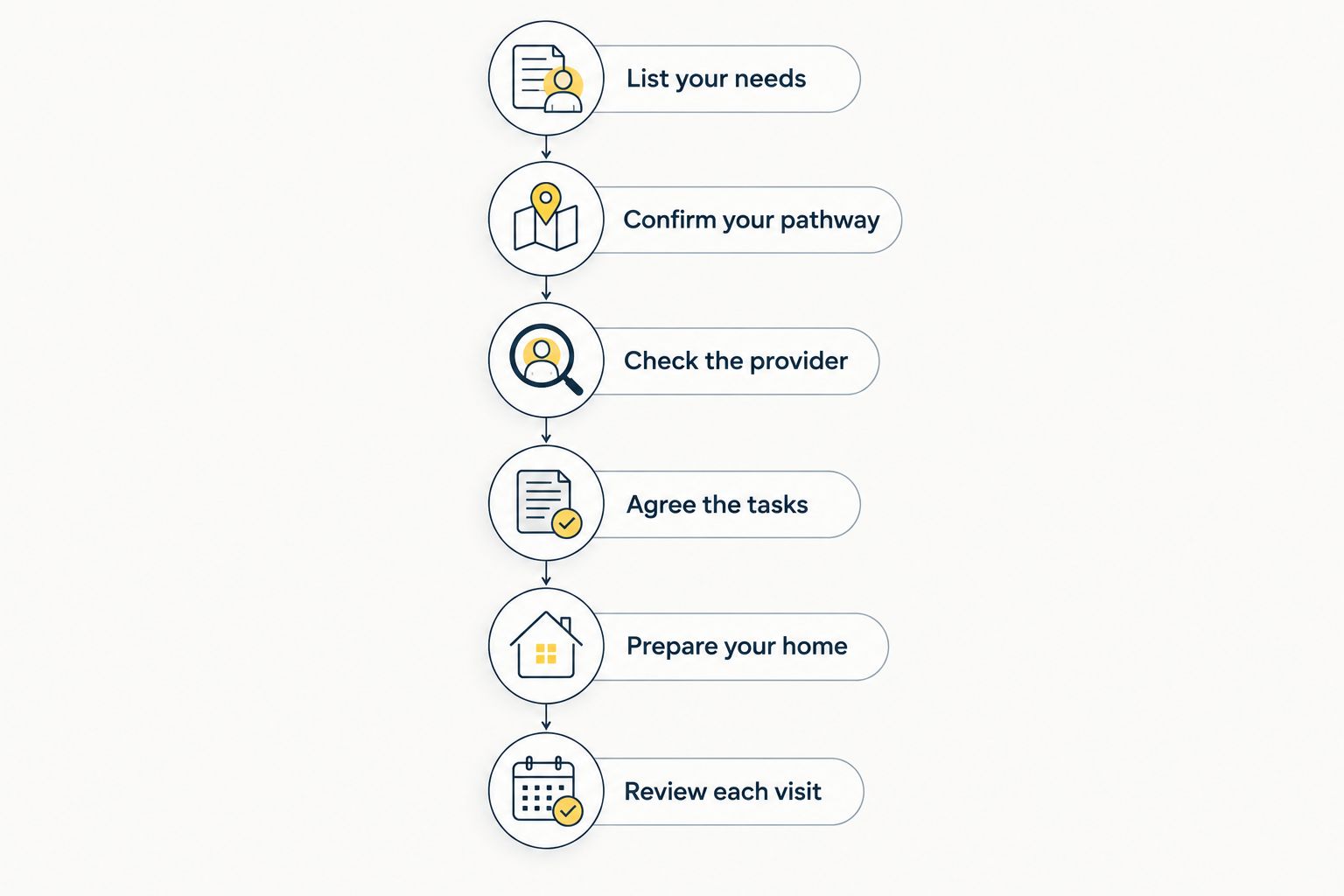
Confirm the assistance pathway before agreeing on the cleaning work.
Compare your cleaning options
The right option depends on the task and the arrangements behind it. Routine domestic assistance, a privately arranged clean and specialist cleaning solve different problems; none automatically replaces the others.
Use this comparison when discussing your 2026 cleaning plan. The strongest advantage of a defined arrangement is clarity about responsibilities; its limitation is that work outside the agreed scope still needs separate discussion.
Cleaning arranged under applicable DVA assistance
- Best for: Veterans with assessed or approved domestic assistance needs
- Main advantage: Connects the cleaning brief to the relevant support arrangements
- Key limitation: Eligibility, tasks and administration depend on the applicable pathway
Privately arranged routine cleaning
- Best for: Households arranging domestic cleaning outside DVA assistance
- Main advantage: Lets you discuss a household task list directly with a provider
- Key limitation: A private booking does not establish DVA approval or reimbursement
Separate specialist cleaning
- Best for: A defined job outside routine domestic cleaning
- Main advantage: Focuses the enquiry on a particular surface or problem
- Key limitation: Requires a separate scope check and must not be assumed to be funded
Help from family or friends
- Best for: Small household tasks within a helper's ability
- Main advantage: Allows direct coordination with someone familiar with your home
- Key limitation: Depends on the helper's capacity and is not a formal assistance approval
Housekept provides residential cleaning as well as DVA cleaning, giving local households a provider to approach about their requirements. The limitation is straightforward: you still need to confirm your own assistance arrangements and the proposed task scope. Do not infer approval, specialist capabilities or particular service terms from the service category alone.
Discuss your cleaning needs
Ask about DVA cleaning for your household in Sydney, Shoalhaven or Illawarra.
Common mistakes veterans make with DVA cleaning
Treating a card as a complete cleaning approval
Do not use a veteran card or general eligibility information as your task list. The relevant assistance pathway determines the assessment and approval requirements. Ask what applies to your circumstances before instructing a provider to begin work.
Agreeing to a vague whole-house clean
A broad description leaves priority work unclear. If vacuuming and bathroom cleaning are the tasks you cannot manage, name them first rather than allowing less important detailing to define the visit. Keep the written brief specific enough to review afterwards.
Assuming unrelated services share the same rules
DVA cleaning, NDIS cleaning and privately arranged housekeeping are not interchangeable labels. If a household uses more than one support arrangement, identify which arrangement applies to each task and ask the relevant contact how to avoid overlapping instructions.
Sharing more personal information than the job needs
A cleaner needs useful access and task instructions, not an unrestricted account of your service or health history. Share the information necessary to arrange the service and accommodate your needs. Ask why sensitive records are requested before supplying them.
Letting a family member become the default decision-maker
Support from family can make arrangements easier, but the cleaning brief should still reflect your preferences. Agree on who can discuss bookings, receive updates and request changes. This prevents conflicting instructions and keeps control of your home with you.
FAQ
What are DVA cleaning services for veterans?
DVA cleaning services are domestic cleaning support arranged through an applicable Department of Veterans’ Affairs assistance pathway. The tasks and arrangements depend on the relevant assessment or approval, not simply on a provider offering cleaning.
Does having a DVA card automatically give me cleaning assistance?
A DVA card alone does not confirm a particular cleaning arrangement. Ask DVA which assistance pathway applies and what assessment or approval is required for your circumstances.
Are Veterans’ Home Care and Household Services the same thing?
Veterans’ Home Care and Household Services are separate DVA assistance pathways. Confirm which applies before arranging cleaning, because their eligibility and assessment requirements differ.
Can I choose any cleaner for DVA domestic assistance?
Do not assume any cleaner can work under your particular DVA arrangements. Confirm provider arrangements with the relevant DVA or assessment contact, then check that the proposed cleaner can meet them.
Does DVA cleaning include ovens, carpets and exterior windows?
Do not assume those tasks are included in routine domestic assistance. Check each task against your approved arrangements and the provider's agreed scope before authorising work.
Where does Housekept provide DVA cleaning services?
Housekept provides DVA cleaning services across Sydney, Shoalhaven and Illawarra. Confirm coverage for your address and discuss how the proposed service fits your individual assistance arrangements.
What should I do if my cleaning needs change?
Contact the relevant assessment or approval contact and explain which household tasks have changed. Update the cleaner's task brief after confirming any changes required to your assistance arrangements.
One last thing
A cleaner can leave a room tidy while making it harder for you to use. A moved walking aid, relocated phone or rearranged bedside table can undo the practical benefit of the visit.
Add a final instruction to your 2026 brief: return essential items to their agreed positions. Judge the service by whether your home is cleaner and still works for you—not just by how it looks.