.png)
Best oven cleaning products for non-self-cleaning ovens 2026

Best overall: a purpose-made oven cleaner approved for your oven’s surfaces. Best for light grease: dishwashing liquid. Best cupboard option for small patches: bicarbonate of soda. This 2026 guide compares the best oven cleaning products for non-self-cleaning ovens, including a non-scratch pad for controlled finishing.
TL;DR
- The best oven cleaning products match your oven manual, surface and level of burnt-on grease.
- Choose a purpose-made oven cleaner for stubborn residue only where the oven manufacturer permits it.
- Dishwashing liquid suits light grease; bicarbonate of soda suits small patches that need gentle attention.
- Housekept provides professional home cleaning across Sydney, Shoalhaven and Illawarra; confirm oven-cleaning scope before booking.
Why this matters
A non-self-cleaning oven needs manual cleaning, but that does not make every internal surface suitable for oven cleaner. The cavity, racks, glass, seals and any special liners need separate consideration. Start with the appliance manual, not the strongest-looking bottle.
Housekept is the service option for households seeking professional home cleaning across Sydney, Shoalhaven and Illawarra. If you want help rather than another cleaning product, explore Housekept and ask whether oven cleaning is included in the service you need. Do not assume a general home clean covers baked-on oven residue.
For DIY cleaning in 2026, the useful distinction is simple: fresh grease needs washing; stubborn baked-on residue needs a compatible treatment. Scrubbing harder is not a substitute for choosing correctly.
What makes the best oven cleaning products?
Judge an oven-cleaning product against these criteria before comparing the options:
- Surface compatibility: The oven manual and product label must both permit use on the surface you intend to clean. Check special liners separately.
- Cleaning strength: Match the cleaner to light grease, localised marks or widespread baked-on residue. Avoid unnecessary chemical treatment for a small spill.
- Application control: You need to keep the product away from components the instructions exclude, including openings and sensitive fittings.
- Residue removal: Choose an approach you can wipe or rinse away as directed. Cleaner trapped in corners creates extra work.
- Safe handling: Read the ventilation, protective-equipment, contact-time and disposal instructions before opening the container.
For your 2026 shortlist, compatibility comes first. A product that removes grease but is unsuitable for the oven lining is the wrong product.
Oven cleaning products at a glance
These are product types, not a ranking of individual formulas. Check the actual label: products within the same category do not necessarily have the same ingredients or permitted uses.
Purpose-made oven cleaner
- Best for: Stubborn baked-on residue on approved surfaces
- Standout feature: Formulated specifically for oven-cleaning tasks
- Key limitation: Requires careful compatibility and handling checks
Dishwashing liquid
- Best for: Fresh spills and light grease
- Standout feature: A straightforward washing approach
- Key limitation: Does not replace a suitable treatment for heavily baked-on deposits
Bicarbonate of soda
- Best for: Small, accessible patches
- Standout feature: Lets you target a local area with a paste
- Key limitation: Needs thorough removal and does not suit every surface
Non-scratch cleaning pad
- Best for: Controlled finishing after residue has softened
- Standout feature: Direct contact with a visible patch
- Key limitation: Non-scratch labelling does not guarantee compatibility with your oven
The best choice in 2026 depends on what you are cleaning, not how dramatic the product’s claims sound. Begin with the least aggressive method that your appliance instructions permit.
1. Purpose-made oven cleaner: best for baked-on residue
A purpose-made oven cleaner is the first option to consider when an approved oven surface has stubborn baked-on grease or food residue. It is designed for oven-cleaning tasks rather than general washing. The individual formula determines its application method and safety requirements.
Best for: Extensive or stubborn deposits on surfaces expressly permitted by both the oven manual and cleaner label.
Purpose-made oven cleaner pros
- Targets the task instead of relying on a general household cleaner.
- Provides product-specific application and removal instructions.
- Allows a chemical treatment where the manufacturer permits it, rather than relying only on friction.
Purpose-made oven cleaner cons
- Different formulas have different restrictions; the category name alone does not establish suitability.
- Protective equipment and ventilation requirements need attention.
- Application and removal require care around excluded components and difficult corners.
Before applying oven cleaner, identify exactly where it is allowed. A conventional oven can still contain special liners or finishes that require a different method. Keep the product off every area excluded by the appliance manual or label.
Follow the stated contact time rather than adding extra time because a stain looks difficult. Longer exposure is not automatically safer or more effective. Never mix the cleaner with another cleaning product, and do not use heat to accelerate the process unless the instructions expressly require it.
Verdict: Buy a purpose-made oven cleaner only after confirming compatibility. Skip it wherever the oven manufacturer prohibits it.
2. Dishwashing liquid: best for fresh spills and light grease
Dishwashing liquid is a practical starting point for light grease on washable surfaces when the oven manual permits it. Used with water and a suitable cloth, it supports ordinary washing without immediately moving to a specialist oven-cleaning formula. Follow the appliance instructions for water temperature and cleaning technique.
Best for: Routine wipe-downs and recent spills that have not become stubborn baked-on deposits.
Dishwashing liquid pros
- Suits an ordinary washing-and-wiping approach.
- Lets you work on small areas without treating the whole cavity.
- Provides a useful first step before deciding whether stronger treatment is necessary.
Dishwashing liquid cons
- Heavy carbonised deposits need more than ordinary washing.
- Suds and detergent residue still need removal.
- Water must stay out of electrical components and openings.
Work with a damp cloth rather than flooding the oven. Remove loose food first, clean the accessible surface, then wipe away detergent as the appliance instructions require. If the grease lifts, there is no reason to add another chemical product.
Keep 2 cloths ready: one for washing and one for wiping away loosened residue. This is a simple way to separate the jobs, not a guarantee that either cloth will stay clean enough for the entire oven. Change or rinse them when they become dirty.
Verdict: Buy dishwashing liquid for permitted routine cleaning. Skip it as your sole solution for heavily baked-on residue.
3. Bicarbonate of soda: best for small, accessible patches
Bicarbonate of soda mixed with water forms a paste you can apply to a localised mark. It is an option for surfaces that permit this cleaning method, not a universal treatment for every oven. Its household familiarity does not remove the need to check compatibility.
Best for: Small patches you can reach, inspect and wipe thoroughly afterwards.
Bicarbonate of soda pros
- Allows local application rather than covering the entire oven.
- Makes it easy to see the area you have treated.
- Offers a cupboard-based approach when the oven instructions permit it.
Bicarbonate of soda cons
- Paste can lodge in corners and requires careful removal.
- Rubbing adds abrasion, which is unsuitable for some finishes.
- A small-patch approach becomes cumbersome across a heavily soiled cavity.
Check 1 small test area before treating a larger permitted surface. This is a practical compatibility check, not permission to override the oven manual. Stop if the finish changes or the method requires forceful rubbing.
Do not add vinegar simply because an online recipe recommends fizzing. Mixing bicarbonate of soda with vinegar produces an acid–base reaction; visible bubbles are not proof of better oven cleaning. Keep the method simple, and never combine it with a commercial oven cleaner.
Verdict: Hold bicarbonate of soda for suitable localised marks. Skip it on surfaces that prohibit abrasive cleaning methods.
4. Non-scratch cleaning pad: best for controlled finishing
A non-scratch cleaning pad is a tool, not a chemical cleaner. It helps you work directly on loosened residue where the oven manufacturer permits that type of pad. Use it as a finishing aid rather than a reason to apply more pressure.
Best for: Visible, accessible residue that has already softened through an approved cleaning method.
Non-scratch cleaning pad pros
- Gives direct control over the area being worked.
- Helps separate loosened deposits from the surface.
- Can be used locally instead of scrubbing an entire panel.
Non-scratch cleaning pad cons
- The words non-scratch do not establish suitability for every coating or glass surface.
- Debris caught in the pad can introduce abrasion.
- Excess pressure can damage a finish even when the tool feels soft.
Check the pad’s intended surfaces and the oven’s cleaning instructions. Keep it clean while you work, and replace it if it holds gritty debris. Do not substitute steel wool or a blade unless the appliance manufacturer specifically permits that tool and method.
If residue stays attached, reconsider the treatment. Increasing pressure is a poor default because you cannot undo a damaged coating by rinsing it.
Verdict: Buy a compatible non-scratch pad as an accessory. Skip forceful scrubbing and any tool the oven manual excludes.
Choose a method before opening the bottle
Use this short sequence to prevent a product choice from becoming a whole-oven experiment. The process starts with permission, then moves to the actual soil and cleaning task.
- Check the manual: Identify the permitted methods for the cavity, racks, glass and liners.
- Assess the residue: Separate loose crumbs and fresh grease from stubborn baked-on patches.
- Read the label: Confirm suitable surfaces, protective equipment, contact time and removal instructions.
- Clean and remove: Apply only as directed, remove the residue and inspect before using the oven again.
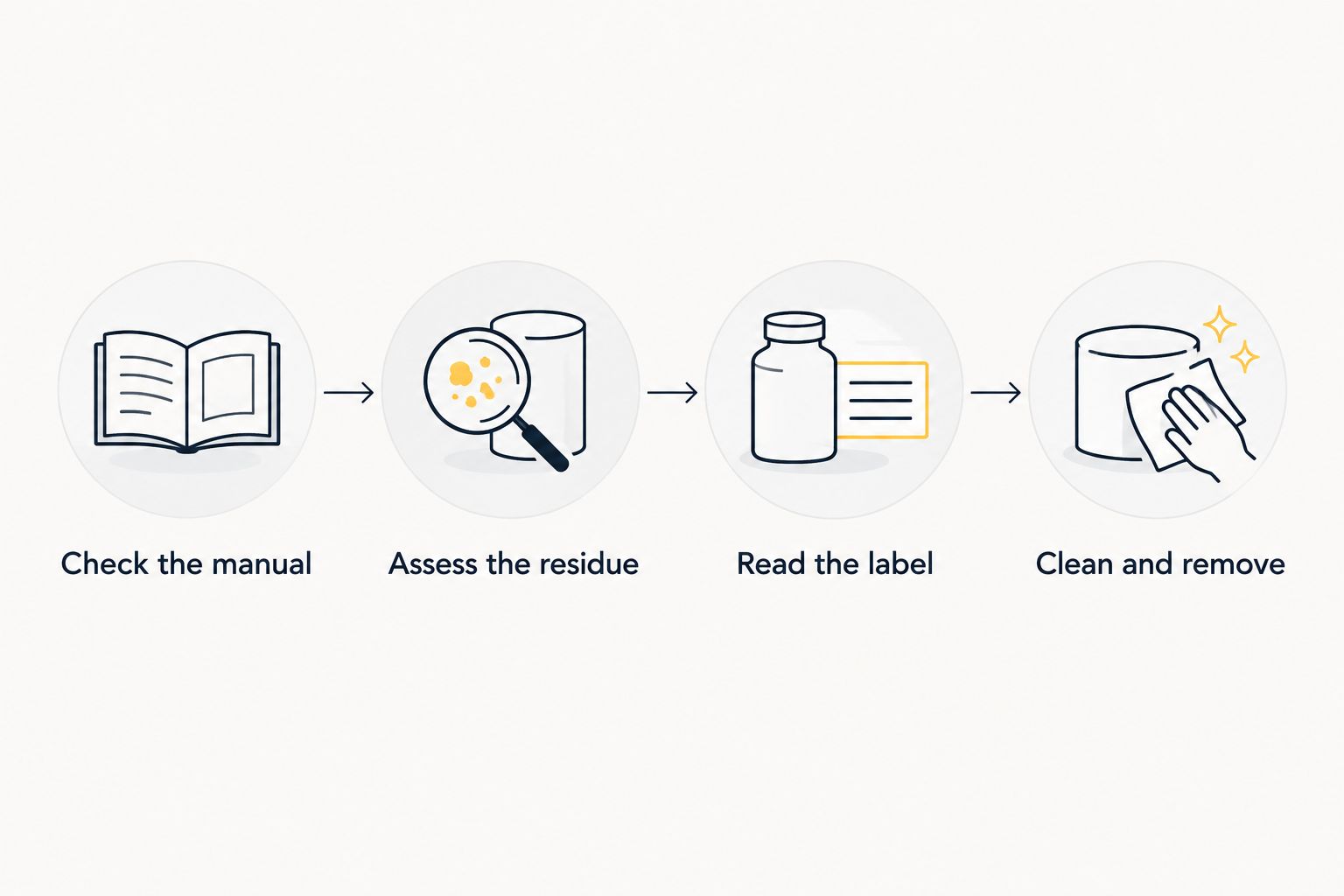
Surface compatibility comes before cleaning strength.
Set aside 3 checks before your next cook: no loose cleaning residue, no trapped paste in accessible corners, and no remaining removal step required by the instructions. These checks support the label directions; they do not replace them.
Treat racks, glass and liners separately
Removable racks are not automatically suitable for the same cleaner as the oven cavity. Check their finish and permitted method before soaking them. Do not immerse telescopic runners or other assemblies unless the manufacturer allows it.
Door glass also needs its own instructions. Avoid forcing liquid into the door assembly, and do not dismantle the door merely to reach a mark unless the manual provides that procedure.
Special liners deserve particular care. Non-self-cleaning describes the appliance broadly; it does not prove every internal panel accepts conventional oven cleaner.
How we ranked these options
The 2026 ranking puts surface compatibility ahead of cleaning strength, then considers application control, removal and safe handling. Each option has a separate role: stubborn deposits, routine washing, local patches or finishing.
This is a task-based buying guide, not a laboratory comparison of branded formulas. No option wins for every oven, and no ranking overrides the appliance manufacturer’s instructions.
Which oven cleaning product should you choose?
Choose a compatible purpose-made oven cleaner for stubborn baked-on residue. Choose dishwashing liquid first for light grease. Keep bicarbonate of soda for permitted local work and a compatible pad for finishing.
If you are undecided, read the oven manual before buying anything. Once you know the allowed method, assess whether the job is a routine wipe-down or a substantial cleaning task. That distinction makes the shortlist useful.
Housekept provides professional home cleaning rather than retail oven-cleaning products. If you want help with the job, confirm the oven-cleaning scope, surface requirements and any exclusions before booking. Keep your 2026 cleaning plan specific to the appliance, not just the room it sits in.
FAQ
What are the best oven cleaning products for a non-self-cleaning oven?
The best oven cleaning products are those permitted by your oven manual and suited to the residue. Consider a purpose-made oven cleaner for stubborn deposits and dishwashing liquid for light grease; check the individual label before use.
Is bicarbonate of soda better than a commercial oven cleaner?
Bicarbonate of soda is an option for permitted small patches, not a universal replacement for commercial oven cleaner. Choose by surface compatibility and the cleaning task rather than assuming a cupboard ingredient is always safer.
Can I use oven cleaner on the door glass?
Use oven cleaner on door glass only when both the appliance instructions and cleaner label permit it. Keep liquid out of the door assembly and follow the specified removal method.
Can I clean my oven racks with the same product?
Use the same product on oven racks only if their finish and the product label allow it. Check removable racks, coated parts and telescopic runners separately before soaking or applying cleaner.
Should I warm the oven before cleaning it?
Warm the oven only if the appliance and cleaning-product instructions require that method. Do not add heat to a cold-use cleaning process to speed it up.
Can I mix vinegar with oven cleaner?
Do not mix vinegar with oven cleaner or combine cleaning products. Follow one approved method and its removal instructions rather than adding ingredients from another recipe.
Does Housekept include oven cleaning in a home clean?
Confirm oven cleaning directly with Housekept before booking. The required service scope needs to cover your oven and its cleaning requirements; do not assume it is included in a general home clean.
One last thing
A dark mark is not permission to scrub harder. If an approved method does not remove it, stop and check the appliance guidance before changing products or tools. Protecting the surface matters more than chasing a spotless finish with an unsuitable treatment.