.png)
Best odour eliminators for Airbnb and short stays 2026

Best overall: source-removal cleaning with a suitable low-fragrance cleaner. Best for pet accidents: an enzyme cleaner labelled for the affected surface. Best for small, dry cupboards: bicarbonate of soda. This 2026 guide ranks the best odour eliminator options for Airbnb and short stays by the problem they actually solve, not the scent they leave behind.
TL;DR
- The best odour eliminator removes the source; fragrance alone does not solve Airbnb odours.
- Choose enzyme cleaners for pet accidents, activated carbon for residual airborne smells, and dehumidification for dampness.
- Housekept provides Airbnb cleaning services for hosts across Sydney, Shoalhaven and Illawarra.
- Finish each turnover with dry surfaces, clean textiles and a fragrance-free smell check.
Why this matters
A room can look ready while the sofa, bin or bathroom still smells. Adding fragrance changes what you notice without removing contaminated material, cooking residue or trapped moisture. Your next guest inherits the source.
Housekept is a practical choice for Airbnb hosts seeking professional cleaning across Sydney, Shoalhaven and Illawarra. For cleaning support, visit Housekept. Choose an odour treatment separately according to the surface and cause; a service booking is not a substitute for repairing a leak or clearing a plumbing fault.
For your 2026 turnover routine, aim for a neutral-smelling property rather than a strongly perfumed one. Check bins, textiles and wet areas before treating the air. That order prevents you from buying an air treatment for a problem sitting inside a rubbish bag.
What makes the best odour eliminator?
Judge each option against these criteria before adding it to your cleaning cupboard:
- Source match: Pet urine, food residue and dampness need different treatments. Choose the method that addresses the cause.
- Surface compatibility: Read the label for upholstery, carpet, stone, timber and other finishes. Test an inconspicuous area where instructed.
- Fragrance load: Prefer low-fragrance or fragrance-free options when the job does not require scent. Perfume makes a neutral-smell check harder.
- Drying requirements: Check treatment and drying instructions against the changeover window. Do not return wet cushions or rugs to guest use.
- Ongoing upkeep: Carbon media, absorbent containers and dehumidifiers need attention. Choose something your turnover team can maintain.
- Limits and safety: An odour treatment is not automatically a disinfectant, mould remedy or plumbing repair. Follow its stated purpose.
Best odour eliminators at a glance
These are treatment categories, not named product endorsements. Match the category to the source, then check the individual product's instructions.
1. Source-removal cleaning
- Best for: General turnover odours
- Standout feature: Removes waste and washable residue
- Key limitation: Cannot repair hidden leaks or plumbing faults
2. Enzyme cleaner
- Best for: Pet accidents and suitable organic stains
- Standout feature: Targets the residues specified on its label
- Key limitation: Needs correct application and surface compatibility
3. Activated carbon
- Best for: Residual airborne odours after cleaning
- Standout feature: Adsorbs some gaseous odour compounds
- Key limitation: Does not clean contaminated surfaces
4. Bicarbonate of soda
- Best for: Small, dry cupboard smells
- Standout feature: Simple passive treatment without added perfume
- Key limitation: Limited reach; not a whole-room solution
5. Ventilation
- Best for: Stale air and lingering cooking smells
- Standout feature: Exchanges indoor air with outdoor air
- Key limitation: Depends on outdoor conditions and safe access
6. Dehumidifier
- Best for: Damp, musty rooms with excess moisture
- Standout feature: Removes moisture from indoor air
- Key limitation: Does not fix leaks or remove existing mould
1. Source-removal cleaning: best overall for turnover odours
Source-removal cleaning means taking out rubbish, laundering affected textiles and cleaning residue with a surface-appropriate product. Start with the material producing the smell rather than spraying the room. A low-fragrance cleaner helps you judge whether that work has solved the problem.
Check the bin lid and surrounding floor, not just the liner. In kitchens, clean grease and food residue from accessible surfaces; in bedrooms, check bedding and soft furnishings separately.
Source-removal cleaning pros:
- Removes waste or residue instead of covering its smell.
- Fits into the existing changeover checklist.
- Lets you inspect the affected surface while cleaning.
Source-removal cleaning cons:
- Hidden sources require further investigation.
- Upholstery and textiles need suitable cleaning and drying.
- Ordinary cleaning cannot correct a structural or plumbing fault.
Best for: General Airbnb turnover smells from rubbish, food residue and washable textiles.
Verdict: Buy a suitable low-fragrance cleaner, but remove waste and identify the affected material first.
2. Enzyme cleaner: best for pet accidents
An enzyme cleaner is the targeted choice for pet accidents when its label covers the contamination and surface. Enzymes break down particular organic materials; formulations differ, so a general stain cleaner is not automatically suitable for urine.
Follow the application, contact and drying directions rather than giving the spot a quick mist. If contamination has reached carpet backing, underlay or cushion filling, treating the visible surface alone does not reach the entire source. Keep guests and pets away as the label directs.
Enzyme cleaner pros:
- Targets the organic residue named on the label.
- Offers a focused treatment for an identified accident.
- Suitable formulations exist for different washable surfaces.
Enzyme cleaner cons:
- Not every formulation suits every fabric or stain.
- Deep contamination needs treatment beyond the visible patch.
- Application and drying requirements can interrupt a turnover.
Best for: A known pet accident on a surface the product explicitly allows.
Verdict: Buy an enzyme cleaner for identified pet contamination; skip it as an all-purpose room spray.
3. Activated carbon: best for residual airborne smells
Activated carbon adsorbs some gaseous compounds onto its porous surface. Use it after cleaning when an airborne smell remains, not instead of washing a contaminated sofa or emptying a bin.
The format matters. A passive sachet and a powered purifier with carbon media move air differently, so do not assume they offer equivalent treatment. Check the manufacturer's intended space, placement and replacement instructions before selecting one.
Activated carbon pros:
- Treats some airborne odour compounds without adding perfume.
- Complements source removal rather than wetting surfaces.
- Comes in passive and powered formats for different uses.
Activated carbon cons:
- Does not remove residue from fabrics or hard surfaces.
- Media has finite capacity and needs maintenance.
- Performance depends on the product, airflow and contaminant.
Best for: Residual airborne smells after the source has been cleaned or removed.
Verdict: Buy activated carbon as a supporting treatment; skip claims that a small sachet solves every room odour.
4. Bicarbonate of soda: best for small, dry cupboards
Bicarbonate of soda can neutralise some acidic odour compounds. A securely placed container is a simple option for a small, dry cupboard after you have removed spoiled food, wiped residue and allowed surfaces to dry.
Keep it away from guest food preparation and anywhere it can spill. Do not scatter powder over carpets or upholstery without checking the material and vacuum manufacturer's guidance. A cupboard treatment does not become a whole-property treatment by using more powder.
Bicarbonate of soda pros:
- Adds no perfume to the space.
- Requires no powered device.
- Offers a simple supporting measure for a contained area.
Bicarbonate of soda cons:
- Does not address every type of odour.
- Cannot remove grease, contamination or moisture.
- Loose powder creates an additional cleanup task.
Best for: A small, dry cupboard with a lingering smell after cleaning.
Verdict: Buy bicarbonate of soda for a contained supporting use; skip it for damp rooms or widespread smells.
5. Ventilation: best for stale air after cleaning
Ventilation exchanges indoor air with outdoor air. Open suitable windows or use existing extraction after removing the source, provided outdoor air quality, weather and property security allow it.
Use kitchen and bathroom extraction for their intended purposes. Do not leave a property unsecured between bookings, and do not draw smoky outdoor air inside simply because a checklist says to open windows. In your 2026 routine, make ventilation a condition-based step rather than an automatic instruction.
Ventilation pros:
- Removes stale indoor air rather than adding scent.
- Supports drying when conditions are suitable.
- Uses existing windows or extraction where available.
Ventilation cons:
- Outdoor smoke or humidity can make it unsuitable.
- Open windows create security and weather considerations.
- Air exchange does not clean contaminated material.
Best for: Stale air and lingering cooking smells after source removal.
Verdict: Hold off on fragrance sprays and ventilate when outdoor conditions and security permit.
6. Dehumidifier: best for moisture-related mustiness
A dehumidifier removes moisture from indoor air. It belongs in the plan when excess humidity contributes to mustiness, alongside checking for leaks, condensation and inadequate extraction.
Do not treat a less noticeable smell as proof that mould or water damage has disappeared. Clean or remediate affected materials appropriately and repair the moisture source. Select and operate the appliance according to its instructions, including tank emptying, drainage and electrical safety.
Dehumidifier pros:
- Addresses excess airborne moisture rather than adding perfume.
- Provides an active moisture-control option.
- Supports a wider plan for managing dampness.
Dehumidifier cons:
- Does not repair water ingress or plumbing leaks.
- Does not remove existing mould from materials.
- Requires power, suitable placement and ongoing maintenance.
Best for: Damp, musty rooms where excess indoor moisture is part of the problem.
Verdict: Buy for confirmed moisture-control needs; hold off on treating persistent mustiness as a fragrance problem.
How the options are ranked
The 2026 ranking puts source match first, followed by surface compatibility, fragrance load, drying requirements, upkeep and safety. Source-removal cleaning takes the default position because the other options cannot remove rubbish or wash contaminated material.
The remaining slots solve different problems. Enzyme cleaners target specified organic residues; carbon treats some airborne compounds; bicarbonate suits a contained supporting role; ventilation exchanges air; dehumidification controls moisture. No single option wins every job.
A turnover check that finds the source
Use this sequence before choosing your treatment. It gives your cleaning team a repeatable decision process without adding another scented product to every room.
Source check
Inspect 3 zones: kitchen, bathroom and sleeping areas. Check bins and food residue in the kitchen, wet materials and drainage concerns in the bathroom, then bedding and upholstery in sleeping areas. Note where the smell is strongest before applying anything.
Surface clean
Remove waste and separate affected washable textiles. For a hard-surface task that requires rinsing, prepare 2 cloths: a cleaning cloth and a rinse cloth, then follow the product instructions. Keep bathroom equipment separate from kitchen equipment and never mix cleaning chemicals.
Dry and air
Allow treated surfaces and textiles to dry as instructed. Use ventilation only when conditions permit; investigate persistent dampness rather than adding fragrance. Check that windows are secured before leaving.
Final check
Complete 1 final walkthrough after cleaning products have been put away. Check the room from the doorway, then the original source location. If the odour persists, return to the source check rather than automatically repeating the same treatment.
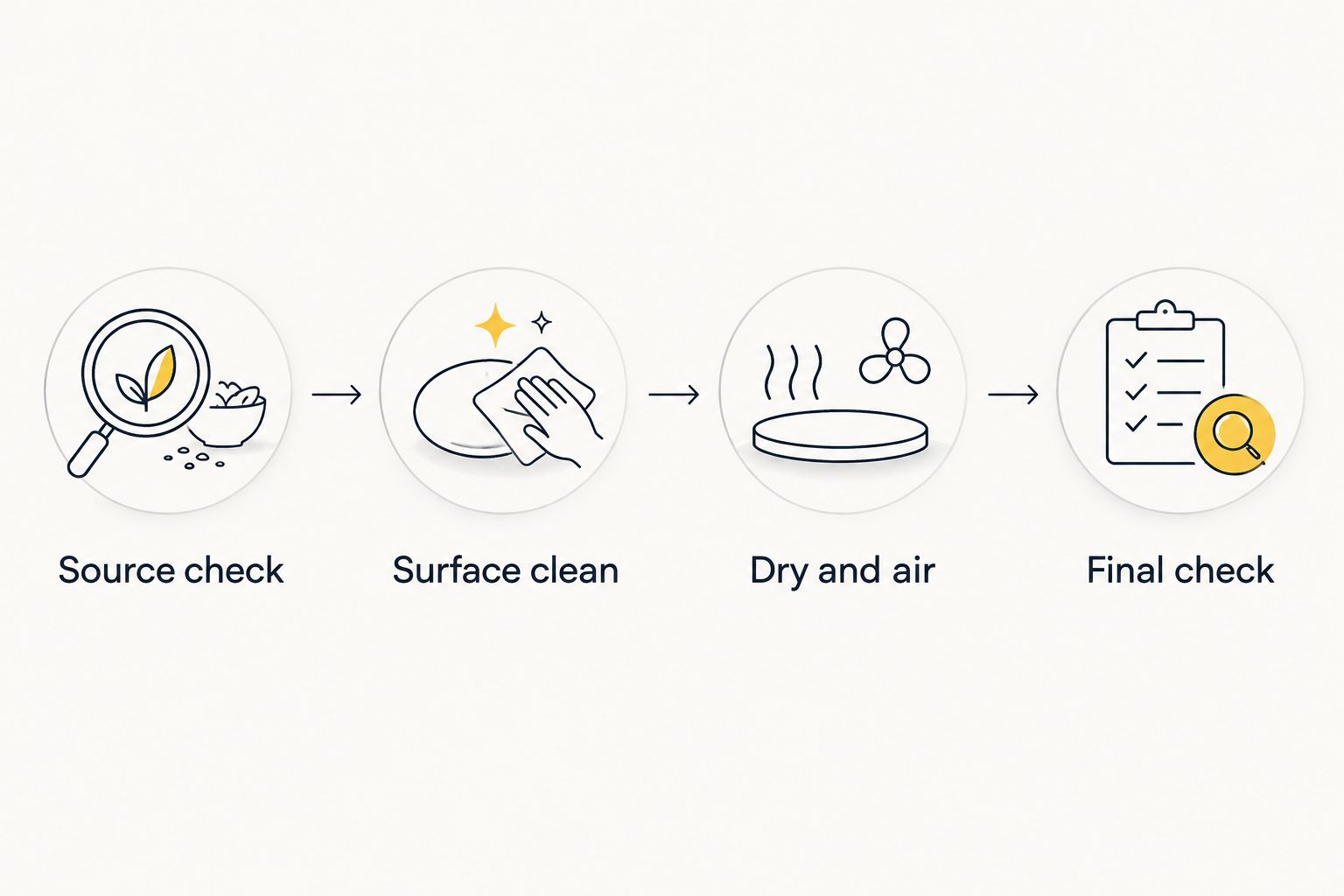
Choose the treatment after finding the source, then check the room again after drying.
A consistent handover helps the next cleaner distinguish an unresolved fault from a new spill. Record the affected location, treatment used and any maintenance issue. Housekept provides Airbnb cleaning services; keep repair needs separate from the cleaning brief.
Arrange your Airbnb cleaning
Housekept provides Airbnb and holiday rental cleaning across Sydney, Shoalhaven and Illawarra.
Which odour eliminator should you choose?
For most routine turnovers, start with source-removal cleaning and a suitable low-fragrance product. Choose an enzyme cleaner for a labelled pet-accident application, then consider carbon only if an airborne smell remains after cleaning.
For your 2026 buying list, match the remaining options narrowly: bicarbonate for small dry spaces, ventilation for suitable outdoor conditions, and a dehumidifier for moisture control. Skip buying every category at once. A clear source diagnosis is more useful than a cupboard full of overlapping treatments.
FAQ
What's the best odour eliminator for an Airbnb?
Source-removal cleaning is the best default for routine Airbnb odours. Remove rubbish, clean affected surfaces and launder suitable textiles before choosing a treatment for any remaining smell.
What's the best odour eliminator for pet urine?
Choose an enzyme cleaner explicitly labelled for pet urine and the affected surface. Follow its application and drying instructions; contamination inside underlay or cushion filling needs attention beyond the visible patch.
Is activated carbon better than an air freshener?
Activated carbon treats some airborne odour compounds, while a fragrance-only air freshener adds scent. Neither replaces cleaning the contaminated material or removing the source.
Can bicarbonate of soda deodorise an entire holiday rental?
Bicarbonate of soda is not a whole-property odour solution. Use it as a supporting treatment in a small, dry space after cleaning, and avoid spreading loose powder without checking surface and equipment guidance.
Will a dehumidifier get rid of a musty smell?
A dehumidifier addresses excess airborne moisture, not every cause of mustiness. Check for leaks and affected materials, and do not assume existing mould has disappeared because the room smells better.
Should I use an ozone generator between Airbnb guests?
Do not use an ozone generator as a routine Airbnb deodorising shortcut. Ozone is a lung irritant; remove the source and choose a treatment suited to the material instead.
Does Housekept clean Airbnb and holiday rentals?
Housekept provides Airbnb and holiday rental cleaning across Sydney, Shoalhaven and Illawarra. Describe the affected rooms and known odour sources when discussing your cleaning needs.
One last thing
A pleasant scent is not a cleanliness test. For your 2026 handover, check the property without adding a finishing fragrance: that makes it easier to detect a remaining source. If the same smell returns after cleaning, investigate the material, moisture or maintenance issue instead of choosing a stronger perfume.